GBTC: Publish your app with easeDiscover GoodBarber Takes Care and simplify the app publication process for both the App Store and Google Play. Let us handle the technical details for you.Learn more about GBTC
Mobile devices have been seen as the bad guy in schools for quite some time now, and administration has fought long and hard to stop kids from bringing their beloved smartphones to class (I definitely endured a gloomy detention or two back in the day for texting during Calc). I think we can all agree that mobile devices can certainly play a negative role in school (they can be a major distraction, facilitate bullying/other inappropriate behaviors, the list goes on..), but the reality is that they are not going anywhere. Diane Barry, an 8th grade Spanish teacher describes prohibiting kids from using their phones as “an uphill battle that can never be won, but if kids can put aside their desire to text, check e-mail, and watch Netflix, mobile devices can be a great tool for everyone”. This is perhaps indicative of the fact that it’s time to start embracing smartphones and tablets in school and explore what kind of benefits they can offer in this previously controversial setting. The spread of technology is only going to increase, especially amongst youth, so if you can’t beat them, join them.
Boost Participation
Thinking back to what my high school classroom looked like on a Monday morning, I really feel bad for my teachers. They basically had to resort to methods of bribery (mostly food) to get a word out of us. Some of this lack of participation can be attributed to shy personalities, but a lot of it is also either boredom or students just not feeling any obligation to participate, as there was nothing forcing them to do so. Integrating mobile devices into class discussions can really up the level of participation, in many ways.
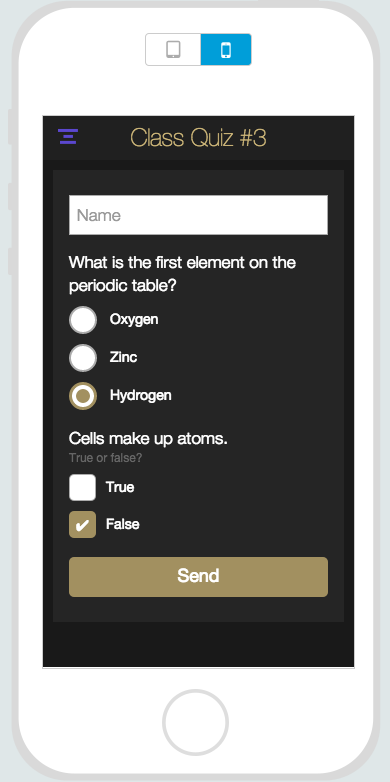
To solve the diffusion of responsibility issue as well as helping out the kids who are too shy to speak, teachers can utilize survey methods, where all students must reply to questions/discussions via their smart devices. Here, there is no opportunity to hide or pass off the question to another classmate—it is clear to see who is and isn’t responding, and those who are not at ease with speaking up in class have an alternative way of expressing themselves. The teacher then has a great starting point for discussions and asking students to elaborate on their initial answer, encouraging verbal participation through the resources they have gathered from mobile responses.
Games on smart devices can also be used for younger groups as a technique for mastering new concepts and maintaining their attention. We know that kids are easily enticed by computer/video games, so using this familiar hobby to disguise otherwise boring learning is a sneak attack method that has already been proven to work (i.e. the thousands of educational apps that have taken off).
When students have a smart device on hand, they will have easy access to all the information they could ever need regarding any discussion imaginable (we can probably assume that nobody is going to whip out the old encyclopedia), so they will be more inclined to chime in with relevant, interesting facts that they can instantly access from their devices. Diane has already seen success in this concept: “Students can use their phones as a quick research tool...my students use their phones to look up words in Spanish and they can also hear the pronunciation...they also use study guides that accompany online textbooks to do quick reviews before a quiz”.
Cost and Practicality Benefits
One of the largest expenditures of schools is textbooks—thousands of dollars are spent on volumes upon volumes that constantly require replacements, and are not even used by students half the time. Why not make a one time investment in a device for every student that contains all information required for any course, as well as updates itself constantly (and don’t cause scoliosis)? Better yet, join the BYOD revolution if it has general approval in your community, and eliminate the cost altogether.
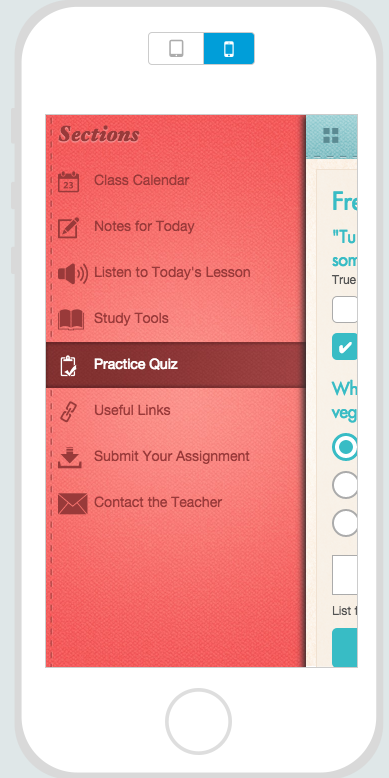
There is also opportunity for cost—and sanity—savings when you consider all of the documents distributed on a daily basis to students—the paper, the ink, it really adds up quickly, and creates a chaotic jumble of never-to-be-found homework assignments stuffed into the backpack. Imagine an app where students have access to viewing and submitting every assignment and practice exercise, downloading notes and information they may have missed, creating chats and boards where they help each other prepare, etc.
By distributing all school documents electronically, giving students the alternative to record notes via photos or videos, and creating a mobile class community, overall organization could really be improved and a lot of mayhem could be avoided.
Prepare Students for Inevitable Aspects of their Future
Just as we had many class sessions dedicated to learning how to type properly and maneuver our way through Microsoft Office, kids in school now will need to learn the essentials of the technology they will be exposed to in the future. Although we can’t predict exactly what kind of technology the future holds, it’s pretty clear that at a minimum, smart devices and social networks will be very present. Being able to smoothly navigate a mobile device is a skill that will be required (or at least very useful) for pretty much every profession, so incorporating these devices into the education system early on will make for an overall more well-adapted and prepared group of individuals.
Another way to integrate mobile into potential career path preparation is by considering the addition of basic developing courses to the curriculum: teaching the very basics of coding, app building, etc. Some may find it absurd to expose kids to such complex and advanced subject matter, but it turns out some of them really enjoy it and have a knack for it! We saw a really neat example of this at the Dublin Web Summit, where a group of kids called CoderDojo was learning all about coding and technology, and they were loving it! It doesn’t hurt to provide an introduction and maybe even a head start to one of the most booming fields out there.
At this point, fighting with kids who bring mobile devices to class is a lost cause. Permitting smart phones and/or tablets to be present lets kids interact with what they are most comfortable with and interested in, keeping them more engaged and likely to actually enjoy learning.
It’s time to say goodbye to the phone in school stigma and give the idea a shot!
On iPhone Duo, an app switches displays every time the phone opens or closes: the outer display, narrow and tall, then the inner display, as wide as a small tablet. Apple asks apps to treat that switch as a simple change of size, like a window being resized, and draws a rule from it: when the device opens or closes, people find what they left.A GoodBarber app follows that rule to the letter. When iPhone Duo opens or closes, it keeps its screens and lays them out again at their new size: the same screen, the same place, what's playing, what was typed into a form. The gesture changes the shape of the screen, never what you were doing.
 eCommerce
 Memberships
 Chatbot
 Online Courses
 Bookings
 Travel guide
 Events
 Content Creators
 Pickup & Delivery
 Newspaper
 Radio
 Schools
 Faith
 Organizations
 Restaurant
 Grocery
 Custom apps
 Employee Communication


 NO CODE APP BUILDER
 TECHNOLOGY
 WHY GOODBARBER?
 Design
 PRODUCT RESOURCES
 TOPICS

 MOBILE APPS RESELLERS
 DISCOVER