 eCommerce
 Memberships
 RAG Chatbot
 Online Courses
 Bookings
 Travel guide
 Events
 Content Creators
 Pickup & Delivery
 Newspaper
 Radio
Radio Schools
 Faith
Faith Organizations
 Restaurant
 Grocery
 Custom apps
 Employee Communication
 NO CODE APP BUILDER
 TECHNOLOGY
 WHY GOODBARBER?
 Design
 PRODUCT RESOURCES
 TOPICS
 MOBILE APPS RESELLERS
 DISCOVER
GoodBarber vs Base44
Written by Muriel Santoni on
Prompt-first or mobile-first: which approach to app creation?
When we compare GoodBarber vs. Base44, we're not just comparing two no-code tools. We're comparing two points of entry into the project.
With GoodBarber, you enter a mobile application through its structure: navigation, sections, design, user accounts, monetization, publication. With Base44, we enter the project by another gesture: we describe the application to an AI, then let the platform generate a first version. This is exactly Base44's public positioning, which focuses on creating apps "with just your words", via AI chat and Visual Edit.
This simple shift changes many things: in one case, you build a mobile app within an explicit framework; in the other, you quickly get a first version generated, then refine it in conversation.
To see what this really means, we've taken up the same use case as in the rest of this series: AURORA - Luxury Guide. As explained in our methodology , this comparison does not seek to cover all the functionalities of each platform. It analyses their implementation in a specific use case.
To remember
GoodBarber is a structured native mobile app builder, designed to produce consistent, quickly publishable iOS and Android apps.
Base44 is an AI-first platform, in which a first version of the app is generated from a prompt, then modified mainly in the dialog box. This is the core of its product logic.
GoodBarber requires more explicit decisions at the outset, but the project remains readable and precisely modifiable.
Base44 impresses with the speed of the first rendering. On the other hand, fine-tuning becomes less intuitive as soon as you leave the initial generated result.
Both allow you to quickly obtain something functional, but not with the same level of control or relationship to the final product.
Joint mini-brief
For this comparison, we asked each platform to produce the same application: AURORA - Luxury Guide, a premium travel companion designed for mobile.
The idea was simple: to design an app capable of bringing together, for several destinations, editorial content, points of interest, a user space with favorites, contextual information such as the weather, as well as a conversational assistant to guide the traveler.
We also integrated a layer of premium content, in order to test monetization, and kept a central constraint in mind throughout the project: the application had to remain fluid, credible and maintainable enough to be piloted by a non-technical team.
This framework is exactly the same as in the rest of the series. What changes here is not the need, but the way Base44 interprets and generates an initial response to that need.
Philosophy & positioning
GoodBarber: an explicit construction logic
With GoodBarber, the application is not born of interpretation.
It's built from visible choices: navigation, sections, user accounts, push notifications, a monetization model, a conversational assistant, and then, if necessary, more specific extensions such as custom code.
For AURORA, we used only the building blocks that were useful for this project: user accounts, bookmarks, notifications, In-App Purchases, Custom Code and the RAG section. This list does not, of course, summarize all that GoodBarber has to offer. It simply corresponds to the scope of the brief.
What really sets the platform apart here is that it asks the team to consciously decide on the app's architecture, rather than having it already generated. In return, the structure remains legible, modifiable and predictable at every stage.
Base44: prompt-first, conversational approach
Base44 takes a different approach. You don't first configure an application screen by screen or section by section. You describe the product in natural language, then the platform generates a first version. Its documentation is very clear on this point: AI is at the heart of the design, build and global changes, while the visual editor is primarily used for targeted on-screen retouching.
In the context of AURORA, what we really used was not primarily a classic builder, but :
the initial prompt
automatic application generation
iteration dialog box
Visual Edit mode for surface adjustments
Of course, Base44 can go further than that. But what counts here is the point of entry: the conversation with the AI.
Create the app with GoodBarber
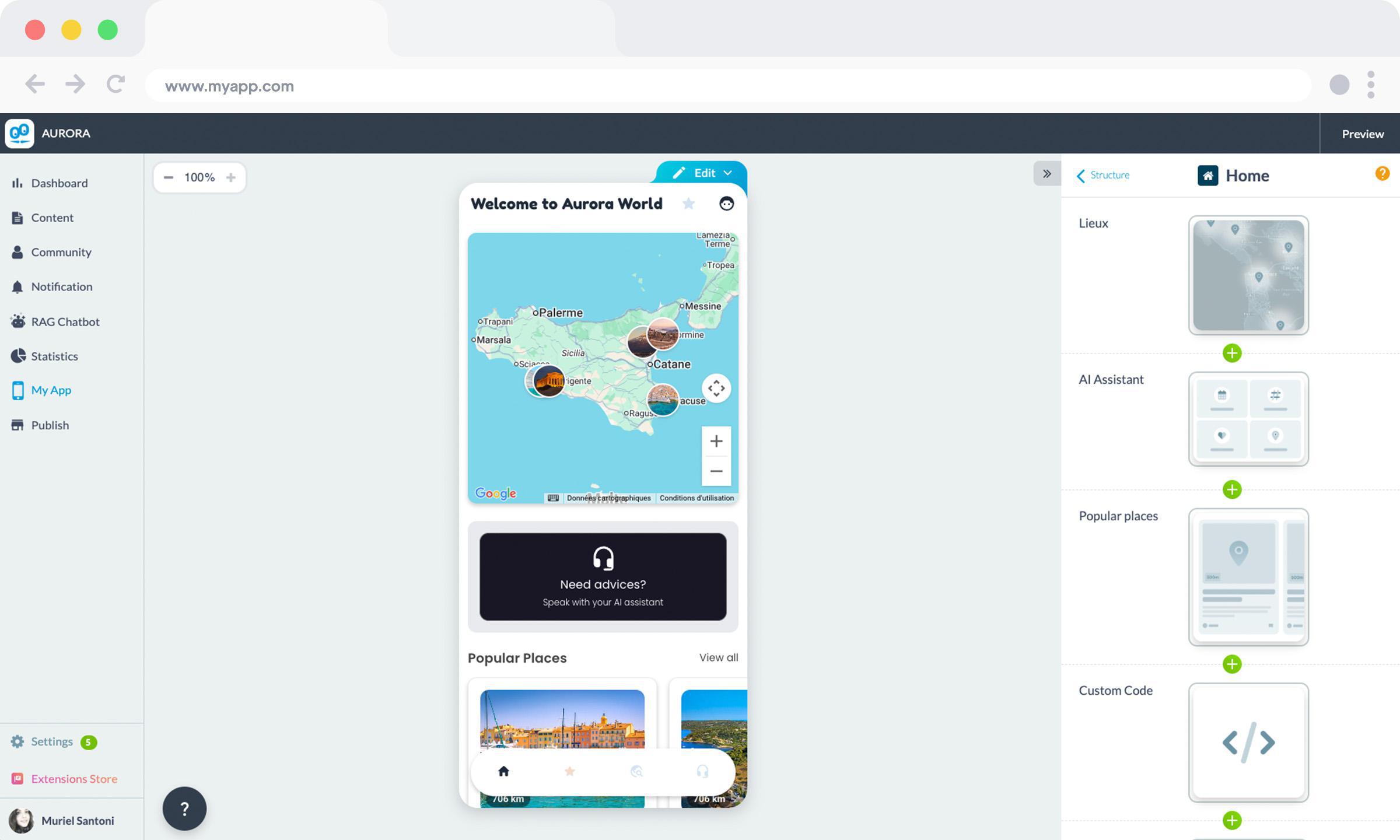
With GoodBarber, AURORA takes shape in visible stages.
We start by defining the navigation, because this is what organizes the mobile experience. For this project, we chose a simple structure:
Home
My Trip
Personal Assistant
About Aurora
Secondary shortcuts were then added in the header for search and user account. This startup is less spectacular than a prompt that generates an entire prototype. On the other hand, it has an immediate advantage: everything is self-explanatory. You know how the application is structured, you know where to act, and you know how to reverse a choice.
The design is then worked on component by component. Layouts, typography, colors, list variants, editorial blocks, animations: you can go far visually, but always from components designed for a coherent mobile experience. We adjust a system already designed for mobile.
Destinations are then created as sections, with a common structure: To See, Agenda, Practical Tips, complementary editorial content. User accounts and favorites are activated without any backend logic to build. Push notifications can be configured within a clear framework. Premium content can be locked via native In-App Purchases.
The weather module uses a Custom Code section and an external API. Finally, the RAG chatbot is added as a dedicated section, connected to the app's content.
The overall feeling is simple: GoodBarber requires a few more straightforward decisions at the outset, but everything remains retrievable, readable and controllable.
Create the same app with Base44
With Base44, the first highlight comes much earlier.
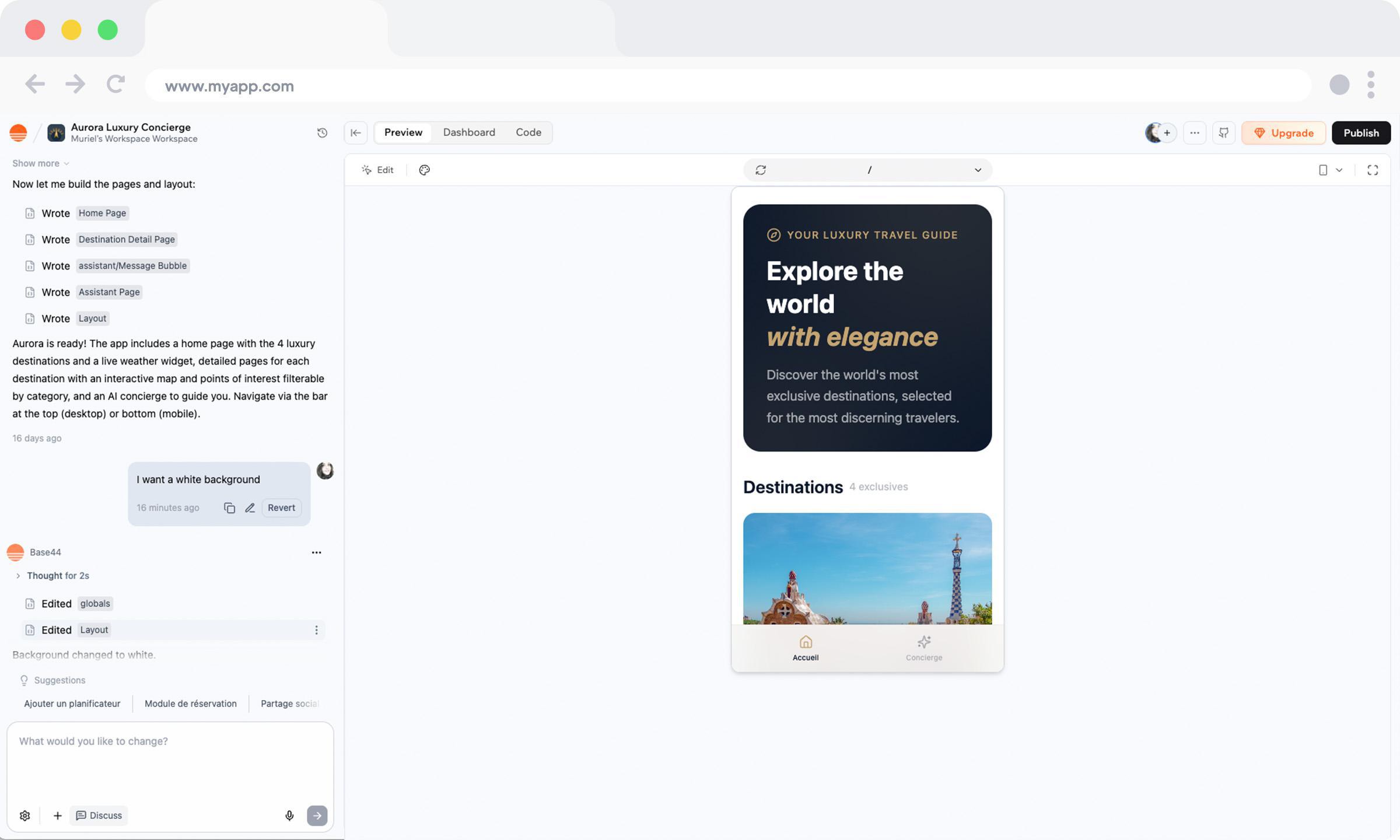
You don't start by choosing a navigation or creating sections. You open the dialog box and describe the application: destinations, content, favorites, chatbot, weather, premium layer. Base44 then generates a first functional version with an interface, data structure, authentication logic and navigation base. This is precisely the promise put forward by the platform: to go from an idea to an app in a very short time, thanks to natural language.
And let's face it: the effect is impressive.
In just a few minutes, AURORA exists. You've got something to show, to click on, to comment on. For a prototype, a demo or a concept test, Base44 goes extremely fast.
The rest is a matter of conversation. As long as we keep to broad requests, it works well: adding a page, changing a global behavior, changing a visual tone, enriching a general logic. The Base44 documentation confirms that AI chat is the main tool for wide-ranging design and structural changes, whereas Visual Edit is mainly used for modifying what you see on screen.
But this is precisely where the relationship with the tool changes.
When you want to be more precise, the experience becomes less intuitive. Modifying the exact hierarchy of a screen, fine-tuning a component, correcting an AI-generated structure or obtaining a very specific variation is not always done directly. You have to rephrase, ask again and repeat. The application is no longer simply edited: it is re-negotiated with the AI.
It's at this point that Base44 moves away from a classic app builder and closer to a vibe coding logic. The first results are quick. Fine-tuning comes later, and sometimes with greater difficulty.
The same logic applies to advanced functionalities. The data schema is generated automatically, which speeds up the start enormously. A weather API connects well. An AI assistant can be connected. Authentication is available right from the start. But the more precise the logic needs to be, the more the team depends on how well the AI has understood the project - and then on subsequent iterations to fine-tune what it has produced.
There's also an important point to note on the mobile side. The Base44 documentation explains that the mobile experience today relies mainly on a web experience usable on smartphones, with additions to the home screen, and that submission to the stores is based on a web view logic. Base44 also points out that certain purely native capabilities, such as native push notifications or full offline, are not natively supported at this stage.
In other words: Base44 is very good at making an app appear quickly, much less so at immediately reproducing the level of integration of a native mobile app builder.
Comparison table
Criteria | GoodBarber | Bubble |
Approach type | Product-first | Prompt-first / vibe coding |
Initial experience | Guided, structured | AI-generated |
| Entry point | Navigation and sections | Prompt and natural language |
Content structure | Ready to use | AI-inferred |
Mobile navigation | Native pre-configured | Generated then adjusted |
Design stage | Dedicated visual editor | AI chat + Visual Edit |
Design freedom | High but limited | Fast to start with, less intuitive to fine-tune |
UX risk | Low | Highly dependent on iterations |
Mobile fluidity | Native by default | Web app / web view mobile |
| IOS/Android publishing | Yes, native | Via web logic / web view |
Push notifications | Native, integrated | Not natively supported at this stage |
In-App Purchase | Mobile native | Not native |
Weather module | API / custom | Natural API integration |
Chatbot RAG | Integrated section | Possible via AI / integrations |
Non-technical autonomy | High | Very high at startup, more variable thereafter |
Overall complexity | Mastered | First hidden, then more diffuse |
Ideal team profile | Non-tech / agency | Product / MVP team |
Complexity, maintenance, scalability
The most important difference between GoodBarber and Base44 is not necessarily apparent in the first few minutes. It's in the way the project evolves.
With GoodBarber, the framework is set from the outset. The application's structure, navigation, sections and main functionalities are explicit. This doesn't make the project more complex: on the contrary, it makes it easier to understand and manage over time. Choices are visible, modifications remain predictable, and maintenance is part of a stable logic. You know where you stand.
With Base44, the initial feeling is more fluid. The application appears very quickly, and the first results are often impressive. But the further the project progresses, the more important the question of control becomes. Part of the structure has been generated by AI, and fine-tuning often involves new iterations in the dialog box. Friction doesn't disappear: it moves.
In practice, this results in two different trajectories:
GoodBarber facilitates project stability and legibility over time
Base44 greatly accelerates start-up, but makes evolution more dependent on the quality of iterations with AI
When should you choose Base44?
Base44 is particularly relevant if :
you want to turn an idea into reality in just a few hours
you're looking for a rapid prototype or MVP
the first result counts more than immediate fine-tuning
you're comfortable with prompt iteration logic
your product is still in the exploration phase
When should you choose GoodBarber?
Choose GoodBarber if :
you want to publish on iOS and Android
you are looking for a true native mobile application
you want to retain control over structure, design and development
you want an application that's easier to maintain over time
your priority is a consistent, long-lasting mobile experience
Conclusion
The GoodBarber vs. Base44 comparison highlights two very different ways of creating an application.
With Base44, the strong point is immediate: AI generation enables you to quickly obtain a first concrete version of the project. This is a particularly interesting approach for exploring an idea, testing a concept or rapidly producing a working prototype.
With GoodBarber, the logic is different. The application isn't generated in one go: it's built within a structured mobile framework, designed to create a coherent, scalable native mobile application. This approach makes the project easier to understand and more predictable over time, especially for a non-technical team.
So the real issue is not which platform is "better" in absolute terms, but the context in which each becomes relevant.
In practice, the choice depends above all on what you want from the tool:
very rapid generation per prompt
or a more controlled construction
rapid prototyping
or a mobile application to be published and developed over time
GoodBarber and Base44 don't meet the same needs.
That's precisely what makes their comparison useful.