 eCommerce
 Memberships
 RAG Chatbot
 Online Courses
 Bookings
 Travel guide
 Events
 Content Creators
 Pickup & Delivery
 Newspaper
 Radio
Radio Schools
 Faith
Faith Organizations
 Restaurant
 Grocery
 Custom apps
 Employee Communication
 NO CODE APP BUILDER
 TECHNOLOGY
 WHY GOODBARBER?
 Design
 PRODUCT RESOURCES
 TOPICS
 MOBILE APPS RESELLERS
 DISCOVER
10 Apps, 1 Agent, 20 Minutes a Day: Manage Multiple GoodBarber Apps with AI
Written by Pierre-Laurent Medori on · Last update:
Agencies and resellers don't manage an app — they manage a portfolio. Ten clients means ten back-offices, ten logins, ten morning checks before any billable work begins. Here is how one AI agent, connected to every client app at once, can run the daily review across all of them — and give you back a portfolio you actually have time to grow.
The part of the job that doesn't scale by hand
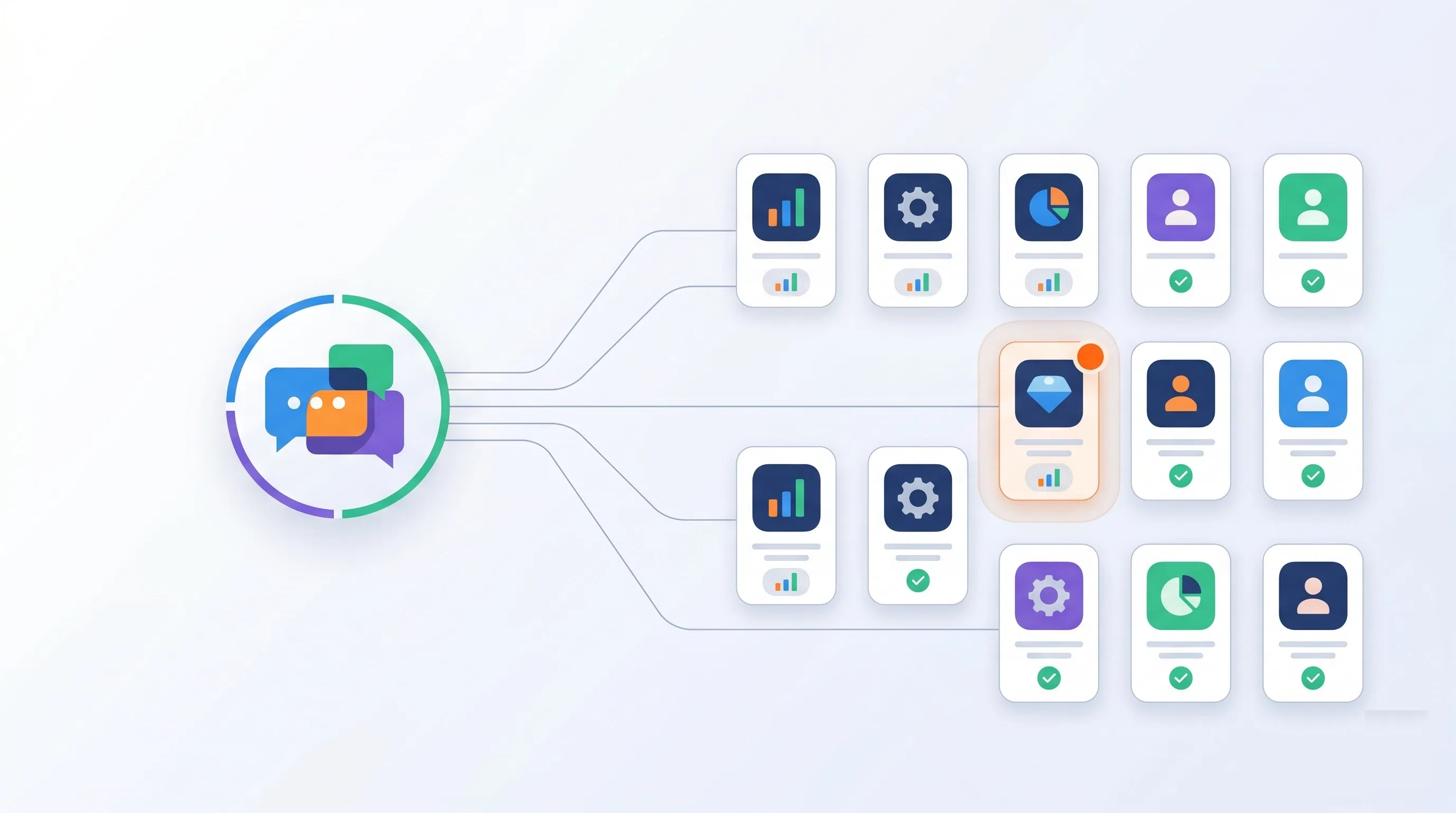
One app is easy. Ten is a treadmill.
Every client app has its own back-office, so every morning is the same loop, ten times over: log in, glance at yesterday's installs, check nothing broke, see whether the last campaign moved anything. By the time you've made the rounds, half the morning is gone — and none of it was the work clients pay you for. GoodBarber's reseller plans are built to hold a portfolio — 100 GB of storage, unlimited staff seats, up to 500,000 push notifications a month — but that headroom lets you take on clients; it doesn't hand back the hours they eat. That part is what an agent takes off your plate.
One agent to manage multiple apps with AI
The mechanic is simpler than it sounds. Every GoodBarber app exposes its own MCP endpoint — a URL carrying that app's unique id, sitting in the app's own back-office. To put a whole portfolio in front of one assistant, a reseller adds each client's endpoint to a single AI client, like Claude. One assistant can now see all ten apps and act on each one by name. No portal to build, no new tool to learn — you connect URLs you already have.
The isolation that protects your clients is what makes this responsible at scale. Each connection is OAuth-authenticated and scoped to one app: an agent connected to App A cannot reach App B. The agent works across your portfolio, but nothing leaks sideways between clients.
You don't open ten back-offices. You open one conversation.
The morning review, delegated
Ask once: "Give me this morning's review across all clients." For each app the agent pulls the same numbers — installs, active users, page views, session time, the device split — and hands back a digest, something like:
- Riverside FC — steady; sessions up after Saturday's fixtures post.
- Atelier No.6 — quiet: nothing published in eight days, page views drifting down.
- Coastline News — yesterday's breaking-news push drove a clear session spike.
You read three lines, not ten dashboards — and the client who needs you is already at the top.
And it doesn't stop at reading. The same surface that reads the numbers can act on them — queue a re-engagement push for the app that's gone quiet, or schedule a fresh article for it (the editorial loop an agent can run inside any single app) — on your say-so.
Twenty minutes, ten clients, one cup of coffee.
Setup in 3 steps
- Grab each app's MCP URL. It's in every app's back-office, carrying that app's unique id.
- Add them to one AI client. Paste each URL into Claude (or your assistant) and sign in once per app with OAuth.
- Brief the morning review. Ask for the cross-client digest, then approve the actions it proposes. That's the whole daily loop.
That's it — no integration to build, no dashboard to wire. The portfolio you already run becomes a portfolio you can review in one conversation.
What stays yours
The agent doesn't replace the account manager. It removes the mechanical layer — the logging in, the gathering, the cross-checking — so your team spends the morning on decisions and clients instead of dashboards.
You still set what "normal" looks like for each app. You still approve every action before it ships; the platform flags each write for verification and waits for your go. You keep the client relationship, the judgment, and the margin. What you stop spending is the hour it took to find out which client needed you today.
That is why this is the highest-leverage way to use the agent layer: it turns portfolio growth from something bound by headcount into something one manager can scale. If you're on a reseller plan, the endpoints already exist — and because the 44 Claude Skills that wrap these workflows are open-source and redistributable, you can rebrand them and hand them to your own clients under your own name.
Frequently asked questions
Can one AI agent manage multiple GoodBarber apps?
Yes. Each GoodBarber app has its own MCP endpoint, found in its back-office. Add several endpoints to a single AI assistant and it operates every app in the portfolio — each one scoped to itself.
Is it safe to connect client apps to an AI agent?
Yes. Every connection is OAuth-authenticated and isolated to a single app: an agent connected to one client's app cannot reach another's. Every change is flagged for verification, and you approve actions before they ship.
What can the agent do across a portfolio?
It reads each app's analytics — installs, active users, page views, session time, device split — and surfaces what changed. It can also act: schedule content and send push notifications, app by app, from one place.
Can resellers white-label this for their own clients?
Yes. The 44 Claude Skills that wrap these workflows are open-source and redistributable under your own brand, with no attribution required — so the agent layer becomes part of your offering, not just your toolkit.