GBTC: Publish your app with easeDiscover GoodBarber Takes Care and simplify the app publication process for both the App Store and Google Play. Let us handle the technical details for you.Learn more about GBTC
A few days ago, along with the release of our new line of PWA products, we published some new features. Amongst them is the option to now send push notifications to Progressive Web App users.
Web push notifications : which browsers are compatible?
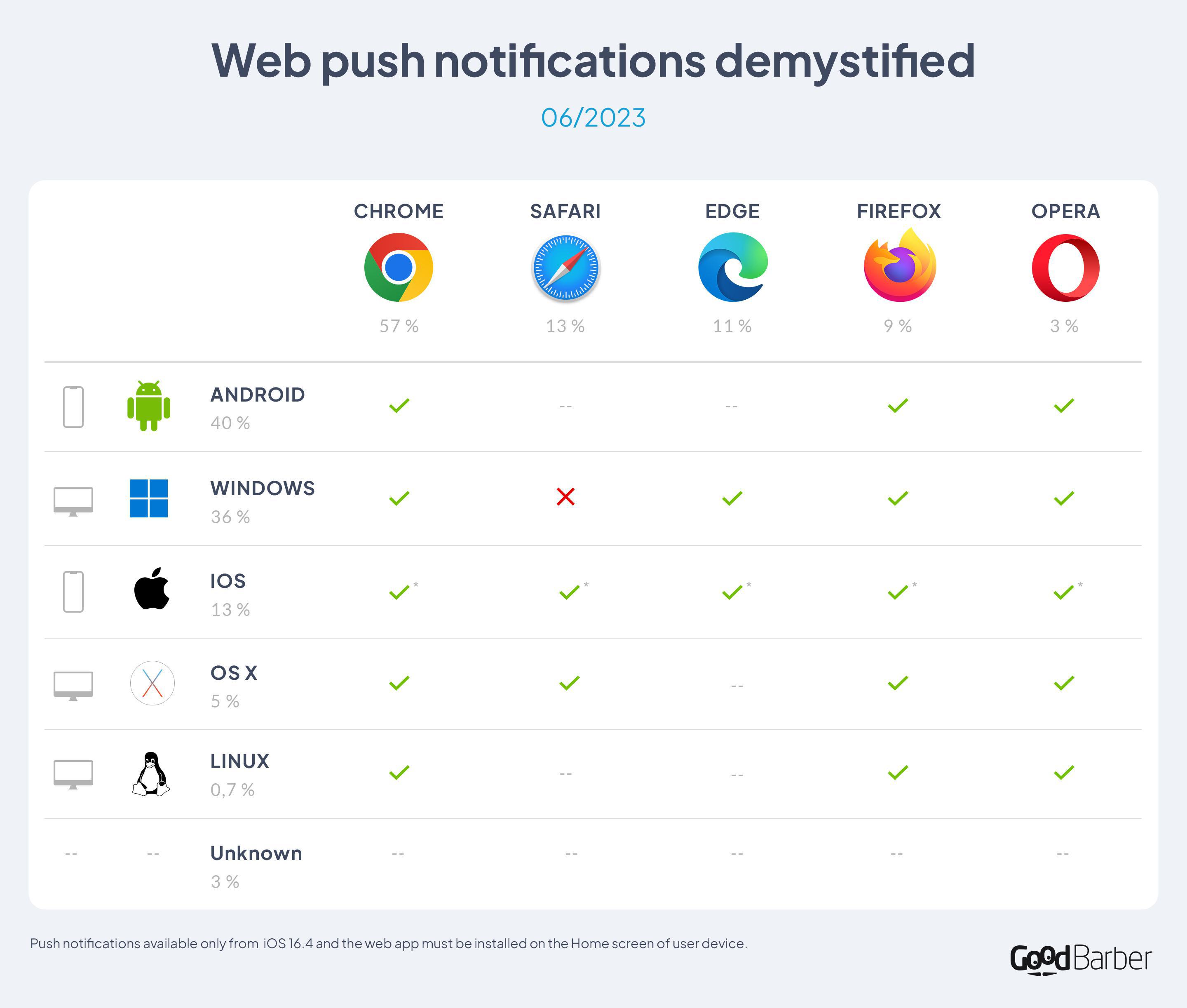
With the Progressive Web App offers, it's possible to send push notifications, which are received directly in the user's web browser. This feature is supported by the majority of recent web browsers, and the list of them is growing every day.
All operating systems have a web browser that can receive push notifications, which is encouraging news. As we've already expressed, PWAs are the future of apps. Even Apple looks like it's making an effort to catch up, with their announcement that push notifications are now supported on iOS and Mac OS, starting from iOS 16.4 and as long as the PWA is installed on the user's device.
Service workers are an essential element that allows PWAs to provide a rich experience. For example, they manage the reception of incoming push notifications in all the browsers listed in the table above. For few exceptions for Safari and iOS. Safari on MacOS, for versions prior to 16.1 or not Ventura, uses a proprietary system that allows notifications to be received in OS X. iOS starting at 16.4 and MacOS Ventura Safari > 16.1 use service workers like the other browsers. And as a reminder, devices using iOS versions older than 16.4 don't support web push notifications.
Prerequesites needed for it to work
If you're curious about how push notifications work, I would suggest you read the How Push Works page in Google's knowledge base. The concept of sending/receiving push notifications is very well explained there.
In order for push notifications to be received, several conditions must be met.
From your side, you must establish a connection between your back office and the third party services used for notification distribution. To establish this connection, you have to generate the key API's and/or certificates in order to guarantee authenticity of the exchanges between GoodBarber servers and the notification distribution services. For Chrome, Firefox, and Opera, we use Firebase, which is Google's platform. For Safari, we use APNs, Apple's platform.
From the final user's side, there isn't much that needs to be done besides visiting the PWA from a browser that's able to receive push notifications (see the table above) and of course, accepting to receive push notifications once on the site.
Then, from your back office, you can send your notifications.
Sending and receiving push notifications
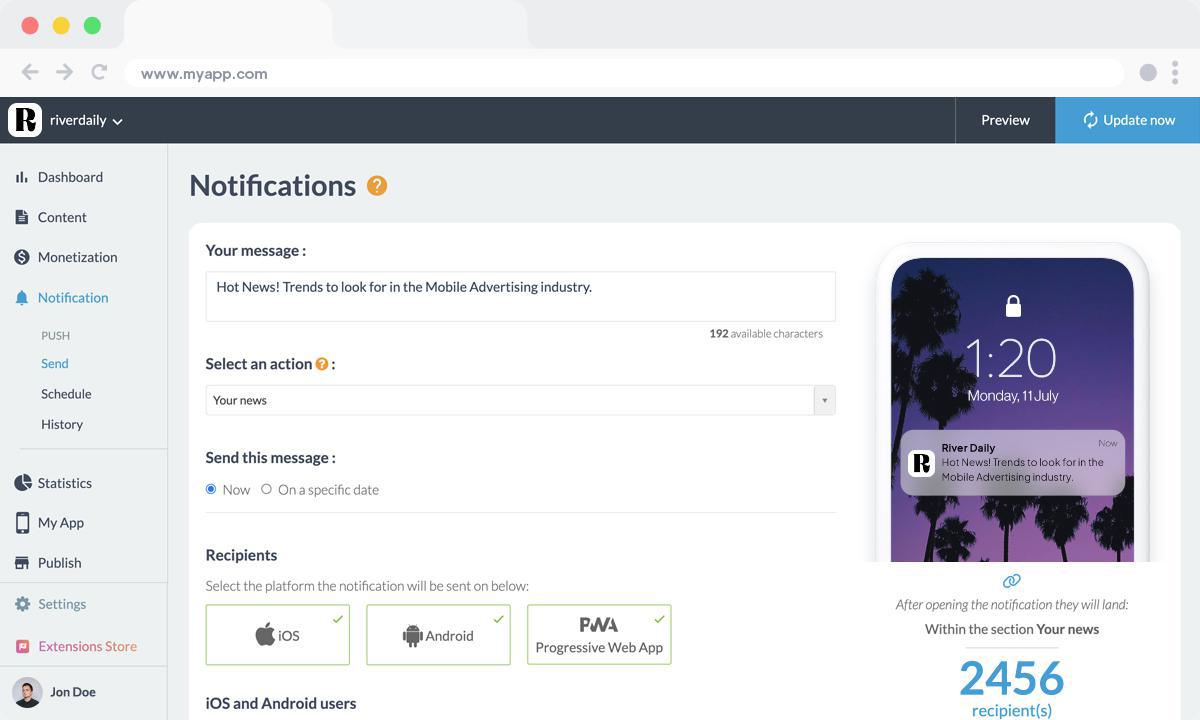
From the page Users > Push > Send, you can create and distribute your push notifications.
- Draft your message - Select the action that will take place when the notification is opened. In the example in the following screenshot, I'm sending my user directly to the page to read the latest news. - Choose the send date of the message, which can be immediate or in the future. You can choose to take the user's time zone into account when notifying them.
This page indicates the number of users (more precisely the number of web browsers) that will receive the notification.
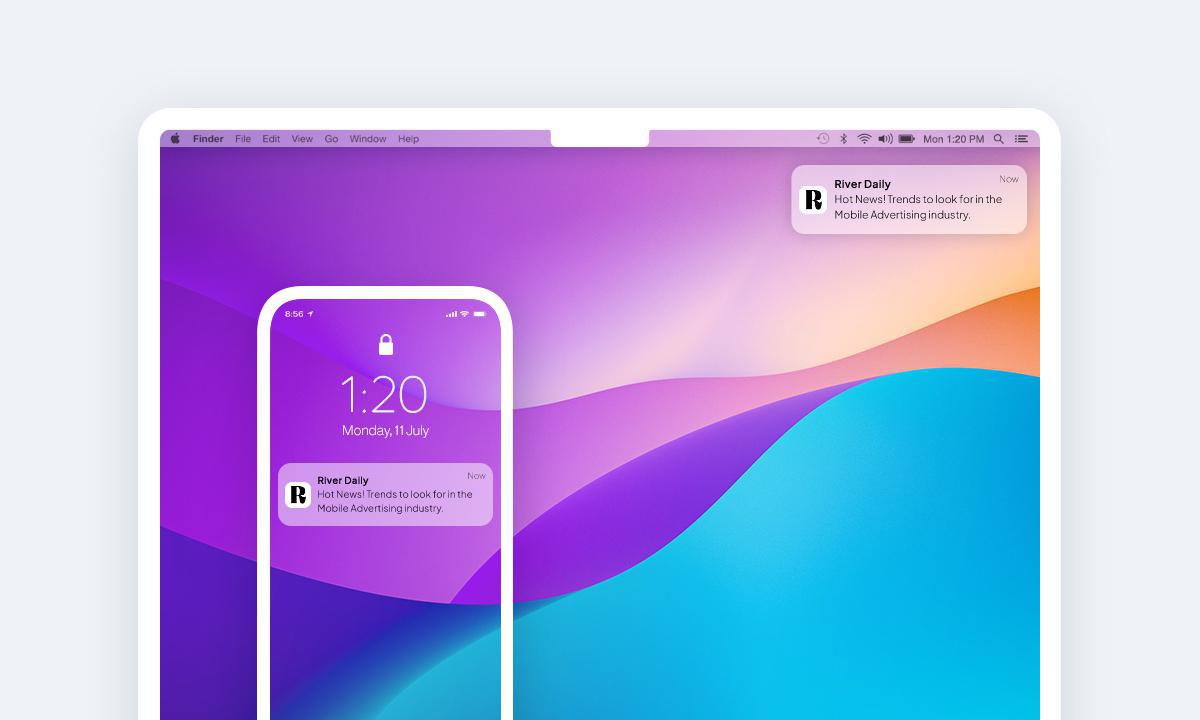
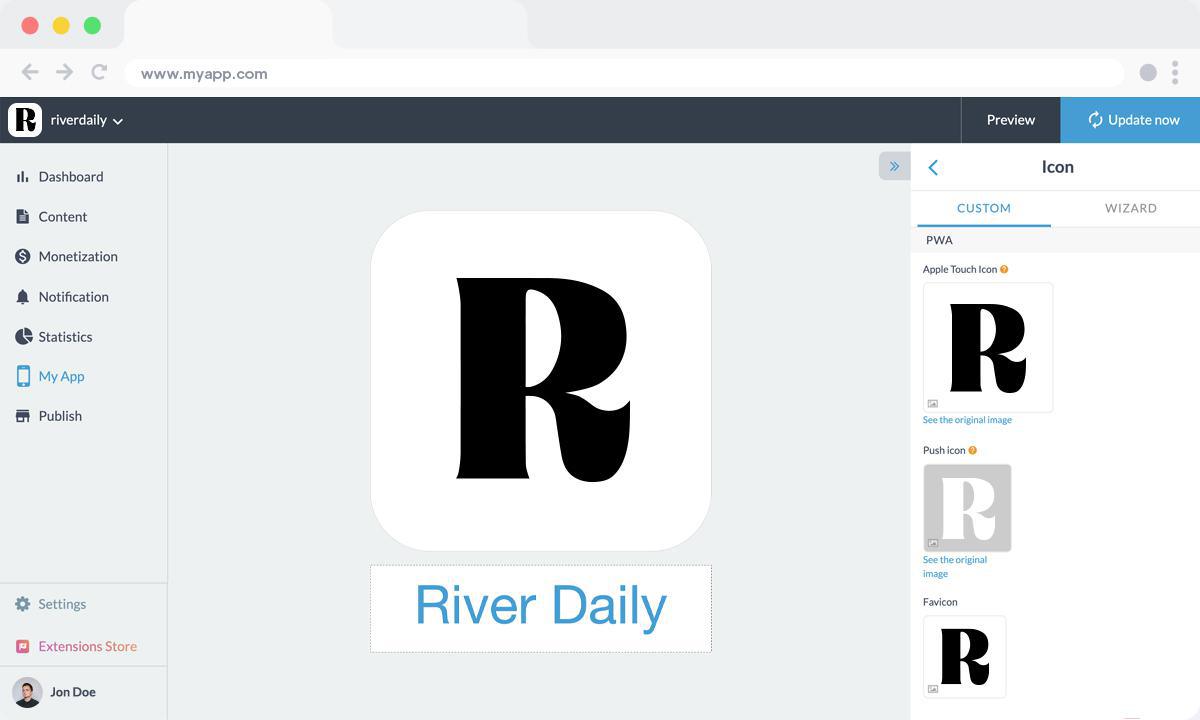
From the user's side, the notification will be displayed on their device. The visual elements in the notification are customizable from the page My App > Icons.
Amongst the icons, you'll find a notification icon for PWA. It should be monochrome on a transparent background. On Android, it is displayed in the phone's status bar when the push notification is received. When you go to the details of the notification, the site logo will appear too.
The Progressive Web App allows you to distribute your app in a universal, free channel : the web. Now that they're equipped with push notificationsGoodBarber PWA's allow you to maintain the line of contact with your web users.
The short version. Zeffy Events and Zeffy Campaigns are two extensions of GoodBarber, the no-code app builder, that read a nonprofit's campaigns on Zeffy. Zeffy Events fills a Calendar section with upcoming events, one entry per date when an event runs on several dates, each with a button that opens its Zeffy ticketing page in the app. Zeffy Campaigns fills an Article section with donation forms, peer-to-peer fundraisers and memberships: memberships open in the app, donations open in the phone's browser. You connect them with your Zeffy API key. Both are free for Content apps: each section counts as one of the extensions included in your plan.Zeffy says more than 100,000 nonprofits have raised over $2 billion through its platform, in an article published on June 16, 2026. Here is how the two extensions play out for a youth theater company that sells its show and raises funds on Zeffy.
In GoodBarber, each color of your theme plays a role. On one of our apps, changing a single color repainted 95 settings at once, without opening a screen.
The short version. Planning Center is an extension of GoodBarber, the no-code app builder, that fills a Calendar section with the events a church publishes on Church Center over the next six months. Recurring events appear once per date, at their public times, in the church's time zone, with their image, location and description. When an event has a sign-up, a button opens the form in the app. You connect it by signing in with a Planning Center Calendar administrator account: there is no key to copy. It is free for Content apps: each section counts as one of the extensions included in your plan.Many churches already run their calendar in Planning Center: it counts 78,000 active churches and 4 million active users, according to its About page, consulted in October 2026. Here is how the extension plays out for a church with a weekly service and a youth retreat.
 eCommerce
 Memberships
 Chatbot
 Online Courses
 Bookings
 Travel guide
 Events
 Content Creators
 Pickup & Delivery
 Newspaper
 Radio
 Schools
 Faith
 Organizations
 Restaurant
 Grocery
 Custom apps
 Employee Communication


 NO CODE APP BUILDER
 TECHNOLOGY
 WHY GOODBARBER?
 Design
 PRODUCT RESOURCES
 TOPICS

 MOBILE APPS RESELLERS
 DISCOVER