GBTC: Publish your app with easeDiscover GoodBarber Takes Care and simplify the app publication process for both the App Store and Google Play. Let us handle the technical details for you.Learn more about GBTC
A typical sequence of events when a company is first created normally begins with establishing the business along with a website, and allowing it time to get on its feet before incorporating supplemental “Add-ons”, such as an application. However, as we’ve said before: apps are no longer an optional, bonus feature, but are rather a must-have for any successful business. Perhaps waiting to create an app isn’t the most strategic choice, and maybe one should even consider it a preemptive step in the entrepreneurial process.
No need to wait around for the physical business to get under way—create the app now and gain traction for later on.
What are the advantages to creating an app first and the physical business later on?
1) Market Research
Starting a product’s life cycle out correctly depends greatly on knowing the market that is being targeted, and applications offer cost and time efficient features that allow one to become informed. Analyses produced from traffic and editorial statistics available to app owners provide valuable, quantifiable data that will lead to a product crafted specifically to the demographics, habits, and interests of the market.
If delving into graphs and statistics isn’t your thing and you prefer to get your information more directly and personally, reaching out to consumers for their input is an effective, simplistic option. Surveys, chat walls, social media interaction, etc. all promote data directly from the customer himself–invaluable to any marketing strategy.
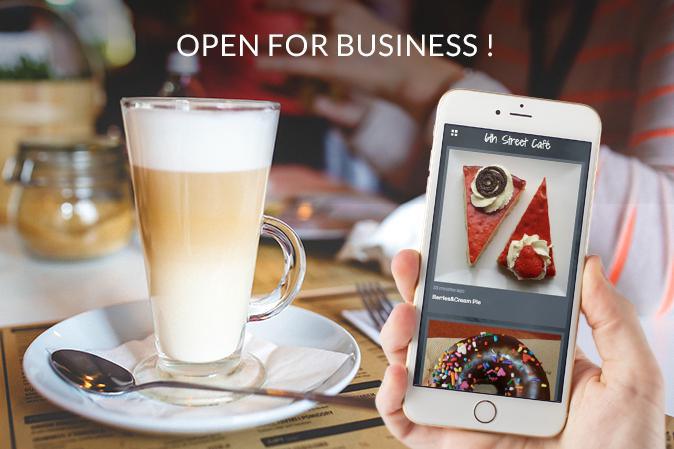
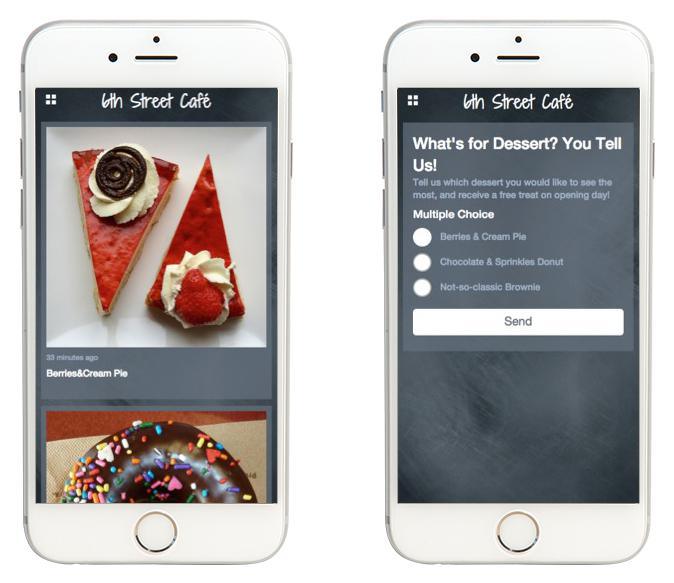
The more enjoyable it is for your user to give you data, the more willing they will be to do so. In the example below, an upcoming café is showcasing it's mouth watering products while requesting compensated feedback from consumers concerning their preferences. It's a simple way to collect data and ensure a full house of enthusiastic customers upon opening.
In addition to gaining information on what your consumers want, statistics regarding number of downloads and amount of engagement can serve as a helpful component in the process of estimating amount of demand.
2) Raising Funds in Advance
Every new business could use a little extra cash, and an increasing number of startups are proving that crowdfunding is an efficient method. Websites such as Kickstarter and Indiegogo are well known for their ability to generate fast cash, and creating a similar platform in an app could be another way to go about this. If you can manage to thoroughly showcase your product and show all of the benefits it could offer, future clients will be eager to help get it going.
The app serves as a space for gathering and displaying your promotional mix: video campaigns, photos, a regularly updated YouTube channel and other social networks will provide an overall impression that can prompt people to contribute to the cause. Provide a donation link, and before you know it you will be well on your way to your goals.
3) Channel for updating future customers and keeping them engaged
Keeping your future clients excited and informed about the launch of your business is crucial, and will build anticipation and credibility that can really serve as a head start. An app that keeps the users updated and allows them to interact will build a sense of community around your brand before it has even been launched.
Various ways to maintain their interest can include contests, special features that are relevant to their interests, and of course, push notifications that keep them informed every step of the way.
Examples of features relevant to user interests can be product reviews for a beauty salon, unique recipes for a restaurant, educational podcasts for a tutoring center, etc. Putting in effort in this sense is a low-cost way to keep the customer interested and significantly raise the app user to customer conversion rate.
Don't be afraid to try this method!
An app is a very efficient promotional tool that provides valuable insight on what can be expected from the early stages of a startup, and can even act as a low cost test for those who are on the fence concerning whether or not to go forward with their business idea. All entrepreneurs should consider including it as part of their strategy—there is no question that an application will be needed sooner or later for the business, so why not adjust the timeline and reap the unique, but often overlooked benefits that will kickstart the company?
The short version. Meta catalog, map and Meta catalog, listings are two extensions of GoodBarber, the no-code app builder, that read an agency's "Home listings" catalog, the XML feed it gives Meta for its real estate ads. Meta catalog, map fills a Map section: each property with a known position becomes a pin with its own page, sorted by distance when the app knows where the user is. Meta catalog, listings fills an Article section with the same properties, newest first. You connect them with the link to your catalog feed. Both are free for Content apps.Agencies build this catalog to reach buyers and tenants where they spend their time. Meta's apps were used by 3.60 billion people a day on average in June 2026, up 3% in a year, according to Meta's second quarter 2026 results published on July 29, 2026. Here is how the two extensions play out for an agency in Hamburg.
The short version. Givebutter Events and Givebutter Campaigns are two extensions of GoodBarber, the no-code app builder, that read a nonprofit's campaigns on Givebutter. Givebutter Events fills a Calendar section with upcoming events, at their time in the event's time zone, with their location unless you share it with attendees only. Givebutter Campaigns fills an Article section with active forms and fundraising pages, with their cover image and description. You connect them with a Givebutter API key. Both are free for Content apps: each section counts as one of the extensions included in your plan.A lot of giving already goes through Givebutter. On Giving Tuesday 2025, supporters gave $20 million on the platform, up from $16.4 million in 2024, from more than 93,000 donors across 16,000 active campaigns, according to Givebutter's recap published on December 8, 2025. Here is how the two extensions play out for an animal rescue.
 eCommerce
 Memberships
 Chatbot
 Online Courses
 Bookings
 Travel guide
 Events
 Content Creators
 Pickup & Delivery
 Newspaper
 Radio
 Schools
 Faith
 Organizations
 Restaurant
 Grocery
 Custom apps
 Employee Communication


 NO CODE APP BUILDER
 TECHNOLOGY
 WHY GOODBARBER?
 Design
 PRODUCT RESOURCES
 TOPICS

 MOBILE APPS RESELLERS
 DISCOVER