GBTC: Publish your app with easeDiscover GoodBarber Takes Care and simplify the app publication process for both the App Store and Google Play. Let us handle the technical details for you.Learn more about GBTC
You developed your new Android app and you are ready to publish it on the Play Store. Indeed, with over 1 billion monthly active users, Google Play is the market place which is most widely preferred for distributing and promoting Android apps. This article is a step-by-step guide on how to successfully publish your app on the Play Store.
Follow these steps to publish your app on Google Play Store:
In order to publish an app in the Play Store, you must create a Google Developer Account which has a one time registration fee of $25. Part of the information provided here, such as the developer name, will be displayed on the Store.
2. Build and test your app
To prepare your application for release, you need to configure, build, and test a release version of your application. Generating your app is a mandatory step in the development process. Google offers tools such as Android Studio to build your application. Once the build is completed and before publishing your application, it is highly recommended to thoroughly test the release version. Testing is essential to the success of your app. It will allow you to check the quality of your app (making sure everything is working as it should), its performance (is it up to industry standards and user expectations, are there any bugs). You will also receive valuable feedback from the user side validating (or not) your ideas on your app and allowing you to make the relevant changes before publishing it on the Play Store.
If you are using GoodBarber, you will find an easy step by step guide to help you build your app and test the adhoc version. Testing the AdHoc version helps ensure that your application runs properly and offers a friendly, intuitive user experience. Ideally, you should test your application on devices with different screen sizes and resolutions to verify that your user interface elements are sized correctly. This step is your opportunity to fine tune your app and make the last modifications necessary.
3. Publish your app
Your App profile in Google Play listing
Once you’ve tested your app thoroughly, you can move on to the next step and publish it on the Play Store.
On your Google Play Console, select “ Create application” then a default language, enter your app title (that will appear on the Store).
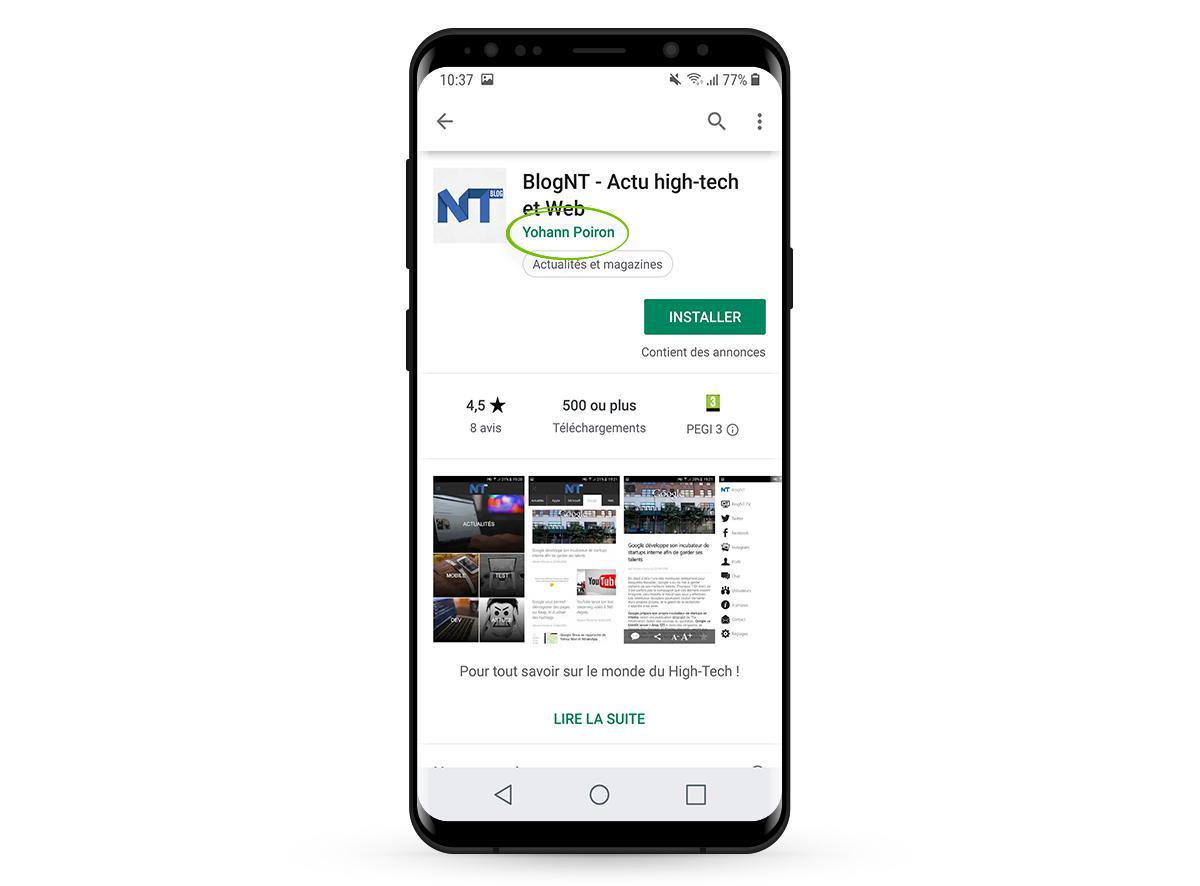
After you’ve created your app, you’ll be taken to the store entry page. This is the step where you register the information that will be displayed on Google Play. It includes mandatory information such as: title, short description, full description, graphic assets, category, contact details, privacy policy.
Some of these information play a crucial role in the Play Store search rankings. The title is the most important factor in search rankings. Your app title should be unique, clear and short (long titles might be truncated on smaller devices). The short description should display the most relevant message of your app, without users having to tap “read more”. Make sure to include relevant keywords. In the long description, describe accurately your app using the right keywords to catch your audience’s attention and highlight the main features.
Now that you have prepared the ground to finally upload your app, it’s time to upload your APK file.
If you are not familiar with what an .apk file is, know that it is the file that is produced as the result of the development of your app.
Android Package Kit (APK) is the file format used to distribute and install apps, and make them work on Android devices. In your Google Play Console, create a release, upload the .apk file and save .
You will now set the pricing and countries of distribution. If you want to publish a paid app or to sell in-app purchases, you need to create a merchant account and link it to your publisher account.
If all the submission steps were done correctly, your app status will be “ready to publish”. You’re almost done. The final step involves reviewing and rolling out your release after making sure you’ve taken care of everything else. The status of your app should now be “pending publication”. Within a few hours, your app will be live on the Play Store.
GoodBarber takes care
If you are using Goodbarber, you will find a friendly, easy to use step by step guide in your app backend. From building your app, testing the AdHoc version, importing your .apk file, to publishing your app, we are here to guide you along the way. And if you really can’t be bothered by the whole process, with the GoodBarber Takes Care option our team does all the work for you. One of the benefits of using GoodBarber app builder ;)
Publishing an app on Google Play is a simple process and can be done quite quickly. However, the most important part is developing a high-quality Android app. By using GoodBarber you will be able to create a beautiful, elegant and powerful app that will help you stand above the thousands of apps launched on the Play Store and we will also guide along the way until your app is successfully published.
Still building the app itself? The Android app builder shows how to create a native Android app with GoodBarber, without code, and publish it on Google Play; the iOS app builder does the same for the App Store.
The short version. Meta catalog, map and Meta catalog, listings are two extensions of GoodBarber, the no-code app builder, that read an agency's "Home listings" catalog, the XML feed it gives Meta for its real estate ads. Meta catalog, map fills a Map section: each property with a known position becomes a pin with its own page, sorted by distance when the app knows where the user is. Meta catalog, listings fills an Article section with the same properties, newest first. You connect them with the link to your catalog feed. Both are free for Content apps.Agencies build this catalog to reach buyers and tenants where they spend their time. Meta's apps were used by 3.60 billion people a day on average in June 2026, up 3% in a year, according to Meta's second quarter 2026 results published on July 29, 2026. Here is how the two extensions play out for an agency in Hamburg.
The short version. Givebutter Events and Givebutter Campaigns are two extensions of GoodBarber, the no-code app builder, that read a nonprofit's campaigns on Givebutter. Givebutter Events fills a Calendar section with upcoming events, at their time in the event's time zone, with their location unless you share it with attendees only. Givebutter Campaigns fills an Article section with active forms and fundraising pages, with their cover image and description. You connect them with a Givebutter API key. Both are free for Content apps: each section counts as one of the extensions included in your plan.A lot of giving already goes through Givebutter. On Giving Tuesday 2025, supporters gave $20 million on the platform, up from $16.4 million in 2024, from more than 93,000 donors across 16,000 active campaigns, according to Givebutter's recap published on December 8, 2025. Here is how the two extensions play out for an animal rescue.
 eCommerce
 Memberships
 Chatbot
 Online Courses
 Bookings
 Travel guide
 Events
 Content Creators
 Pickup & Delivery
 Newspaper
 Radio
 Schools
 Faith
 Organizations
 Restaurant
 Grocery
 Custom apps
 Employee Communication


 NO CODE APP BUILDER
 TECHNOLOGY
 WHY GOODBARBER?
 Design
 PRODUCT RESOURCES
 TOPICS

 MOBILE APPS RESELLERS
 DISCOVER