GBTC: Publish your app with easeDiscover GoodBarber Takes Care and simplify the app publication process for both the App Store and Google Play. Let us handle the technical details for you.Learn more about GBTC
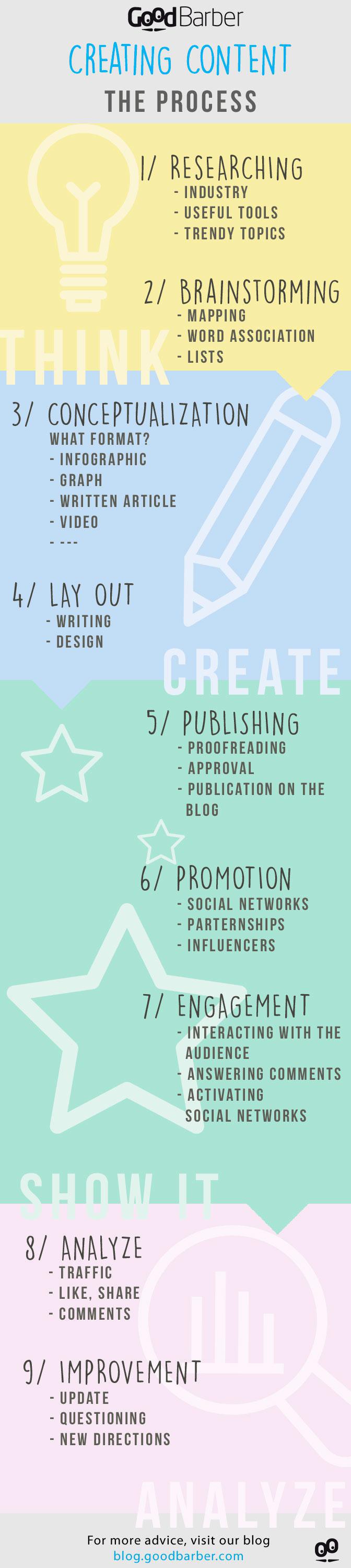
It’s no secret by now that great content is a significant marketing asset. It’s a strategy which has proven useful time and time again. Even if beneficial to the businesses that rely on it, it can also be quite demanding and time consuming. Small businesses often can’t afford to dedicate an actual team to the task and can, as result, feel somewhat lost when faced with the challenges of content creation. That is why we've decided to put together a quick tutorial for you, to pinpoint the main stages the creative process, with an infographic, synthesizing the information while serving as a reminder for future use ;)
Step 1: THINKING
Before coming up with content, thinking obviously comes first… But what are you supposed to focus your attention on? First of all, the topics to deal with. Do research on websites and magazines which are relevant in your field, keep up to date with the news of the industry and trendy topics. It’s your best shot at reaching an audience.
Once you’ve isolated the topics you’re interested in tackling, discuss them with your team. One of the common mistakes when creating content is seeing the copywriter isolating himself, at the risk of offering too personal of a point of view on topics, or even worse, missing an important point. On the contrary, brainstorming is an excellent way to bring about ideas, confront different insights and find the right angle to tackle topics. There are also several other techniques to stimulate creativity: mapping, word association, creating lists, you name it!
If teamwork matters, how you organize your work when you are on your own, faced with a blank canvas (or screen) matters just as much. Of course, you'll want to give thought to the tools you can use to organize your day, but also bear in mind the imponderable, such as, maybe, the fact that you concentrate better in the morning. In that case, try to organize your day accordingly, tackling content related tasks in the morning, when you are more focused. If you are easily distracted, organizing your schedule can imply turning off notifications on your desktop, or even your smartphone. The bottom line is, find what works best for you to get the job done and stick to it!
Step 2: CREATING
It’s time to get creative! When creating content to promote your brand or your business in general, content creation goes beyond copy writing, with decisions such as picking the right layout for your content, or even the format: should an infographic or video come along with it? The fact is, visual content is known to create more of an impact on readers. Even more so on social media where the competition is fierce and, at least images, are a requirement to deliver an impactful message. Yet, be realistic when it comes to your skills, time ressources and above all, budget.
Writing and packaging content is time consuming indeed, and will require your undivided attention. Making sure you pick the right words to express your ideas is important, checking grammar and syntax as well. It also doesn't hurt to involve your colleagues or your friends, to have a second opinion and avoid any typos or mistakes that could undermine your work. The same goes with design. It should, at least, be aligned with your brand identity. What's more, choose colors wisely and pictures with high quality. You aren’t much of a graphic artist? Turn to free stock photos websites such as Unsplash where you can find high quality images, for free! Once again, be realistic. It’s best to go for a simple yet qualitative result, rather than being too ambitious and doing a half job.
Step 3 : SHARING
The time has come to publish your content. Don’t forget one more round of proofreading before hitting the publish button. Then, once your content is published on your blog or website, you have several tools at hand to promote it. Of course, your social media channels should be put to good use. To increase your visibility, rely on your network at first, it's a natural yet efficient way to drive more traffic towards you content, but also improve your pages' ranking. Don't be afraid to ask from a thumbs up or "heart" from your close circle. You can extend the circle to business partners and even, if you’re bold enough, influencers in your area of expertise (no need to stress the importance of one's content being flawless to catch the attention of this specific tough audience).
Now, don’t stop just yet. You will also want to ensure that your content generates engagement, even long after it's published. Not only will it make your content strategy more profitable, but it's also a great way to keep in touch with your users and get to know them better. Read and learn from their reactions, interact with them on social media and below the original article,learn to manage even negative comments. It will demonstrate your reactivity as well as your flexibility.
Step 4: ANALYZING
Creating successful content also means updating and refreshing it on a regular basis. Of course, it all starts with analyzing your statistics, for recently published articles as well as archives. The traffic it brings, the interactions it prompts, your referrals, use tools such as Google Analytics, and monitor your content's performance closely. As for social media platforms, Facebook, Twitter, Pinterest or even Instagram, they all provide details statistics now. Use this data to further identify what works with your audience and what doesn't. And if necessary, adapt your future content strategy or improve existing content.
In the end, analyzing statistics isn't only useful to communicate with your audience better, but it can also improve your content's SEO. From design to copy, reviving your content is key for your strategy to actually pay off.
Siri Actions now answers two new questions: the latest article and the latest video in a section of a GoodBarber iOS app. Siri names the item and offers to open it by voice. They reach every app with its next store update. Siri Actions is the set of questions a GoodBarber iOS app answers out loud, for newspapers, radio stations, schools, organizations and any app that publishes content. Its first question, "What's new", gives an overview of your home screen. When we launched it in September 2026, we said the next one would be the latest article in a section. Here it is, and the latest video comes with it. Each goes straight to one item and offers to open it. Your audience goes from a question to the article in a single conversation, without searching for it.
 eCommerce
 Memberships
 Chatbot
 Online Courses
 Bookings
 Travel guide
 Events
 Content Creators
 Pickup & Delivery
 Newspaper
 Radio
 Schools
 Faith
 Organizations
 Restaurant
 Grocery
 Custom apps
 Employee Communication


 NO CODE APP BUILDER
 TECHNOLOGY
 WHY GOODBARBER?
 Design
 PRODUCT RESOURCES
 TOPICS

 MOBILE APPS RESELLERS
 DISCOVER