GBTC: Publish your app with easeDiscover GoodBarber Takes Care and simplify the app publication process for both the App Store and Google Play. Let us handle the technical details for you.Learn more about GBTC
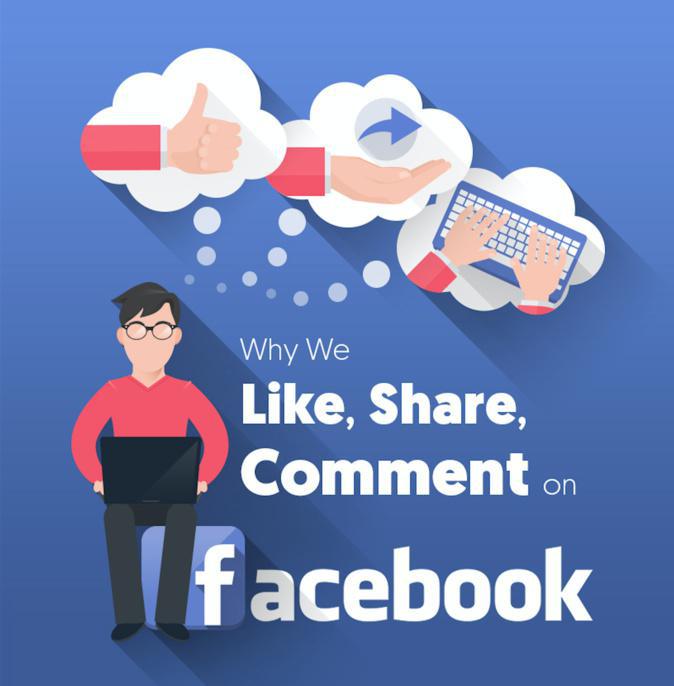
Increase Your Viralness: Study the Behavior of Facebook Users
When setting up a social network strategy, the ultimate goal we are trying to reach is creating interaction with our audience. Appealing information that is widely spread by internet users is the meaning of buzz, and therefore synonymous with boosting visibility.
Every community manager is on the quest for more shares, so we often test many types of posts and measure the results in order to understand which has the most impact on our audience depending on the industry we're working in.
But let's be pragmatic, maybe first we should try to understand what is motivating us and all of our fellow viewers to share content on social networks—Facebook in particular.
This is the question posed by Neil Patel , co-founder of several American startups, including Quickspourt .
1) Why do we "like" something on Facebook?
Liking something on Facebook is a quick and simple action that can have many possible objectives:
-To confirm something about ourselves
A study done on 58,000 people demonstrated that it is possible to discover certain characteristics about someone just based on the content they have liked on Facebook. From this, you can figure out their gender, sexual orientation, political preferences, etc.
So, we aren't "liking" things just for our own entertainment, but also for others to be aware of our preferences, and therefore to form an image about us. This is a great reason to share high quality content, as it brings credibility to the person sharing it.
- To express virtual empathy
This is a concept seen increasingly often that evolved at the same time as social networks. Virtual empathy consists of demonstrating support by sharing an emotional state though the help of a virtual action, like a Facebook like.
In your case, this empathy can can be applied in cases of "personal" posts, like life-related events of your business (reaching a milestone, or acknowledging a change in your community, for example). If you do this the right way, your emotions can serve as a form of communication.
- To get something in return
According to a Syncapse study , a large amount of people like pages out of self-interest: to participate in an event, receive discounts, take part in games or contests, or just be informed and appreciative of a brand and what it wants everyone to know.
So, give them a good reason to follow you and share your content, you will see that you have a lot of options!
2) Why do we comment?
Comments are obviously more personal than likes. Whether it's for the author or for the recipient, according to a study by Moira Burke, they are more satisfying. Commenting implies extra effort, which means there is a greater amount of motivation present. A comment, compared to a like, allows you to show full support, to definitively confirm your belonging to a group, or even to show that you are informed enough to take part in a debate.
- To inform: 61% of users would share things that they deem interesting and 43% would share things they consider important. This helps the user to play an informational or educational role.
- To distract: 43% of users prefer to share funny content, in order to change ideas and share emotions.
- To show our personality: as seen in the above case, we learned that 37% of Facebook users share content in order to inform everyone on what they believe, and to give an idea of who they are.
- To advise: a large number of shares consist of giving an opinion and therefore advice. 30% of us share content with the goal of recommending a movie or product, for example.
- To raise awareness: 29% share in order to support a cause, and make their network aware of this cause.
- To improve reputation: 29% share to enter into a conversation, and 10% to demonstrate their knowledge on a subject.
This is precious information that can help you to effectively adapt the content you circulate on Facebook. By being aware of your audience's motives, and by following the rules of Facebook etiquette that you already know, all that's left is increasing your traffic and visibility.
You know that there are many ways to create enticing posts that will interest your audience and encourage interaction, so be creative and innovative. Don't put all your eggs in one basket and try to add some variety to the types of posts you make in order to satisfy the highest number of viewers!
In GoodBarber, each color of your theme plays a role. On one of our apps, changing a single color repainted 95 settings at once, without opening a screen.
The short version. Planning Center is an extension of GoodBarber, the no-code app builder, that fills a Calendar section with the events a church publishes on Church Center over the next six months. Recurring events appear once per date, at their public times, in the church's time zone, with their image, location and description. When an event has a sign-up, a button opens the form in the app. You connect it by signing in with a Planning Center Calendar administrator account: there is no key to copy. It is free for Content apps: each section counts as one of the extensions included in your plan.Many churches already run their calendar in Planning Center: it counts 78,000 active churches and 4 million active users, according to its About page, consulted in October 2026. Here is how the extension plays out for a church with a weekly service and a youth retreat.
The short version. HelloAsso Events and HelloAsso Campaigns are two extensions of GoodBarber, the no-code app builder, that read an association's public forms on HelloAsso. HelloAsso Events fills a Calendar section with upcoming events, with their date, venue and prices, and a button to register in the app. HelloAsso Campaigns fills an Article section with memberships, donation forms and fundraisers: memberships open in the app, donations open in the phone's browser. You connect them with your association's HelloAsso API credentials. Both are free for Content apps: each section counts as one of the extensions included in your plan.HelloAsso is where many French associations already sell their tickets and collect their memberships. In February 2025, it passed two billion euros collected for associations since 2009, half of it in the previous 18 months, and it counts 376,000 registered associations, according to Le Journal des Entreprises on March 6, 2025. Here is how the two extensions play out for a neighborhood sports club.
 eCommerce
 Memberships
 Chatbot
 Online Courses
 Bookings
 Travel guide
 Events
 Content Creators
 Pickup & Delivery
 Newspaper
 Radio
 Schools
 Faith
 Organizations
 Restaurant
 Grocery
 Custom apps
 Employee Communication

 NO CODE APP BUILDER
 TECHNOLOGY
 WHY GOODBARBER?
 Design
 PRODUCT RESOURCES
 TOPICS

 MOBILE APPS RESELLERS
 DISCOVER