 eCommerce
 Memberships
 Chatbot
 Online Courses
 Bookings
 Travel guide
 Events
 Content Creators
 Pickup & Delivery
 Newspaper
 Radio
 Schools
 Faith
 Organizations
 Restaurant
 Grocery
 Custom apps
 Employee Communication


 NO CODE APP BUILDER
 TECHNOLOGY
 WHY GOODBARBER?
 Design
 PRODUCT RESOURCES
 TOPICS

 MOBILE APPS RESELLERS
 DISCOVER
Agent-Ready Apps: Why Your App Must Be AI-Operable in 2026
For fifteen years, software raced to be easier for people to operate. That race is ending. The next one is whether your app can be operated by an AI agent at all. Here is what "agent-ready" means, the five things it takes, and why 2026 is the year it stops being optional.

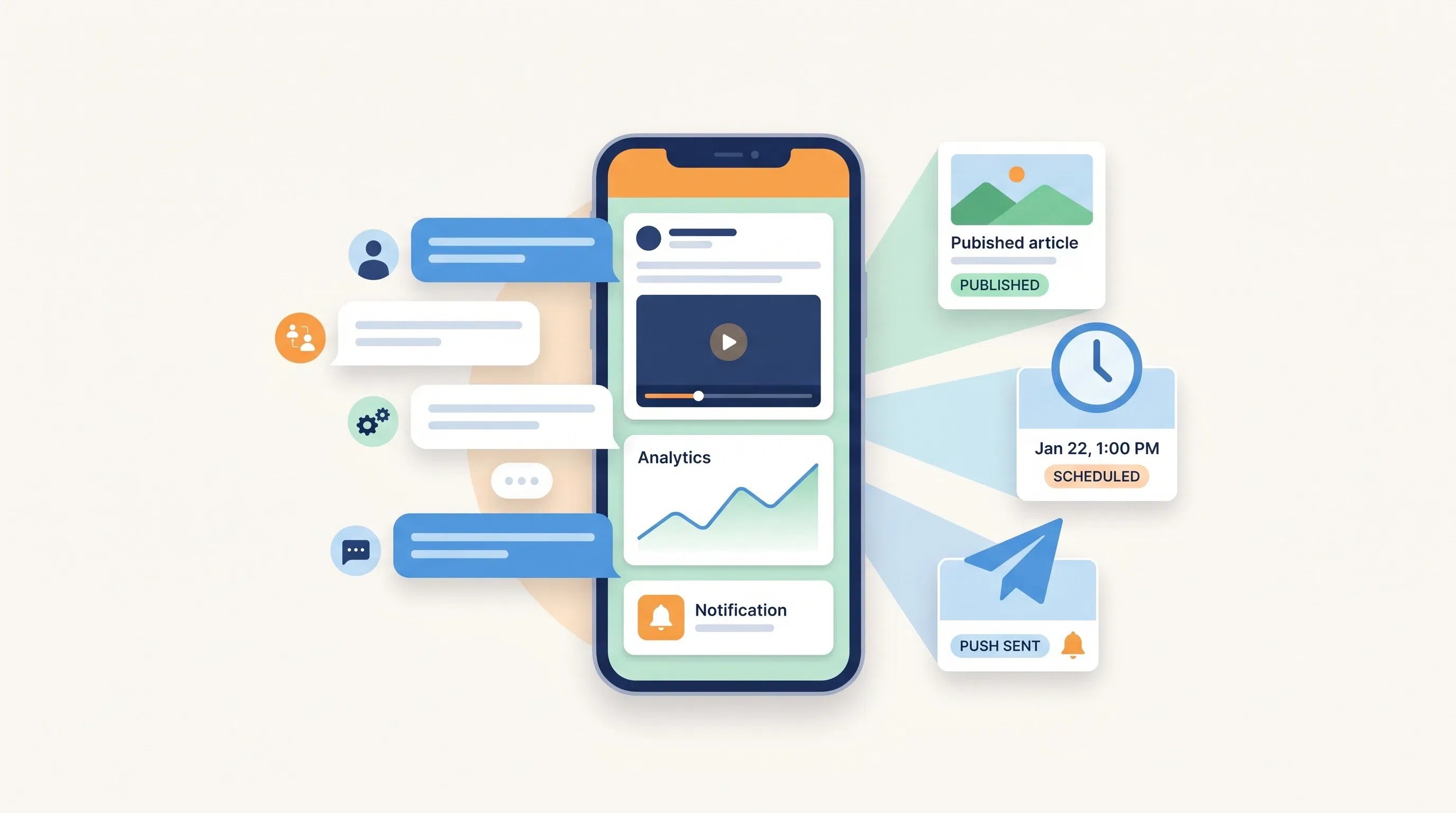
From operating your app to an AI agent running it
You run an app. Every week you open a dashboard, publish a few things, schedule a push, check yesterday's numbers, fix a price. That dashboard got friendlier every year — the whole no-code promise, and it worked. Millions of people now operate professional apps without code.
But the operator is changing. People are starting to hand that weekly routine to an AI assistant: "Publish these three articles, schedule a push for each, and tell me which section lost readers last week." The assistant doesn't want a friendlier dashboard. It wants an interface it can call.
That single fact reorders everything. The interface that wins the next decade isn't the one humans like best. It's the one an agent can drive.
What "agent-ready" actually means
An app is agent-ready when an external AI agent can operate it on the owner's behalf — read its data and perform real actions — through a machine-callable interface, safely and within bounds the owner sets.
Read that twice, because it cuts against the obvious assumption. An app with a chatbot bolted on is not agent-ready. An app with "AI features" inside its own dashboard is not agent-ready either. Those are AI you use inside the app. Agent-ready is the opposite direction: your app being usable by the AI you already work with — Claude, ChatGPT, Cursor, whatever assistant sits in your day.
Agent-ready isn't AI in your app. It's your app in your AI.
The five things that make an app agent-ready
"Agent-ready" is becoming a sticker, so here is a concrete test. An app qualifies only when all five are true:
- A callable interface. Operations exposed as functions an agent invokes — not a screen it has to scrape.
- An open standard. It speaks the Model Context Protocol (MCP), so any assistant connects without a custom build for each one.
- Scoped, authenticated access. The agent signs in as the owner (OAuth) and acts only inside bounds the owner sets.
- Real operations, not read-only. It can publish, schedule, notify, sell, and report — not just fetch data.
- Verifiable and reversible. It confirms before acting and reports after; the human stays in the loop.
Miss one and you don't have an agent-ready app. You have an app with an AI sticker on it.
How GoodBarber makes an app agent-ready
Monday, 9 a.m. You tell your assistant: "Publish the three drafts in my folder, schedule a launch push for each, and tell me which section lost readers last week." Ninety seconds later it reports back: three articles live, three pushes queued, one section flagged as slipping — with a re-engagement post already drafted. You never opened the back-office.
That isn't a concept. Every GoodBarber app runs behind a public Model Context Protocol server — the open standard from the test above — exposing the operations an agent needs, under OAuth, scoped to a single app. We introduced it as voice-and-agent control, and it already covers the whole loop: an agent can manage your content by conversation, schedule it, fire a push, manage a catalog, read last week's sessions. The shape, briefly: 150 operations, 44 ready-made Claude Skills on GitHub, and you connect the assistant you already pay for — we don't resell the model.
So the five criteria aren't a wish list here; they're the spec. And you stay the operator: the agent verifies before it acts, and you review what it did.
We didn't bolt AI onto the product. We made the product something AI can run.
Why agent-ready apps matter in 2026
Two things converged. Assistants that can hold a goal and call tools went mainstream. And the protocol that connects them to real software — MCP — became a de facto standard across the industry. Separately, each was interesting. Together, they flip a default.
A buyer choosing software in 2026 can now ask a question they couldn't in 2023: "Can my agent run this?" Increasingly, they ask it first. Software that answers no will feel — very quickly — the way software without an API felt a decade ago: usable, but on the wrong side of where everything is going.
It won't matter equally to everyone tomorrow, and we won't pretend it does. A solo shop with five products has time. But the direction is one-way: apps don't become less operable, and the teams delegating their routine now are the ones with the most time back a year from now.
How to make your app agent-ready
If you run a GoodBarber app, the agent layer already exists — you connect to it, you don't build it. See the exact operations an agent can run on the MCP page, point your assistant at your app, and brief it like a colleague. If you'd rather start from a recipe, the workflows are packaged as an AI agent you can drive today.
The app you manage by hand today is the app your agent runs next year. The only question worth asking now is whether yours is ready.
Frequently asked questions
What does "agent-ready" mean for an app?
An app is agent-ready when an external AI agent — like Claude, ChatGPT, or Cursor — can operate it on the owner's behalf: read its data and perform real actions through a machine-callable interface, safely and within limits the owner sets. It is the difference between software a person clicks through and software an agent can drive.
Is an agent-ready app the same as having an AI chatbot?
No — they point in opposite directions. A chatbot is AI you use inside your app. Agent-ready means your app can be used by the AI you already work with, from outside. An app can have a chatbot and still not be agent-ready, and the reverse is just as true.
What is the Model Context Protocol (MCP)?
MCP is an open standard that lets AI assistants connect to external software and call its operations as tools. Because it is shared, any MCP-aware assistant can operate an MCP-enabled app without a custom integration built for each one. It is the connector that makes "agent-ready" practical instead of bespoke.
What makes GoodBarber apps agent-ready?
Every GoodBarber app sits behind a public MCP server exposing 150 operations, authenticated with OAuth and scoped per app, plus 44 ready-to-use Claude Skills on GitHub. An agent can publish and schedule content, send notifications, manage a catalog, and read analytics — and you connect the AI you already pay for, with no extra infrastructure to host.
Does agent-ready mean the AI runs my app without me?
No. Agent-ready means the door is open for an agent to act on your behalf — not that you have left the room. You design the app, set the policy, and review what the agent does. The agent confirms before it acts and reports after.


