 eCommerce
 Memberships
 Chatbot
 Online Courses
 Bookings
 Travel guide
 Events
 Content Creators
 Pickup & Delivery
 Newspaper
 Radio
Radio Schools
 Faith
Faith Organizations
 Restaurant
 Grocery
 Custom apps
 Employee Communication
 NO CODE APP BUILDER
 TECHNOLOGY
 WHY GOODBARBER?
 Design
 PRODUCT RESOURCES
 TOPICS
 MOBILE APPS RESELLERS
 DISCOVER
Apple and Google change the rules. What happens to your app?
A headline about Apple tightening something, an official email written in impenetrable jargon, a deadline somewhere — and that question: does this concern me? Here is what is really at stake when a store changes its rules, why it looks like no technical failure you know, and the only two things that stay in your hands.

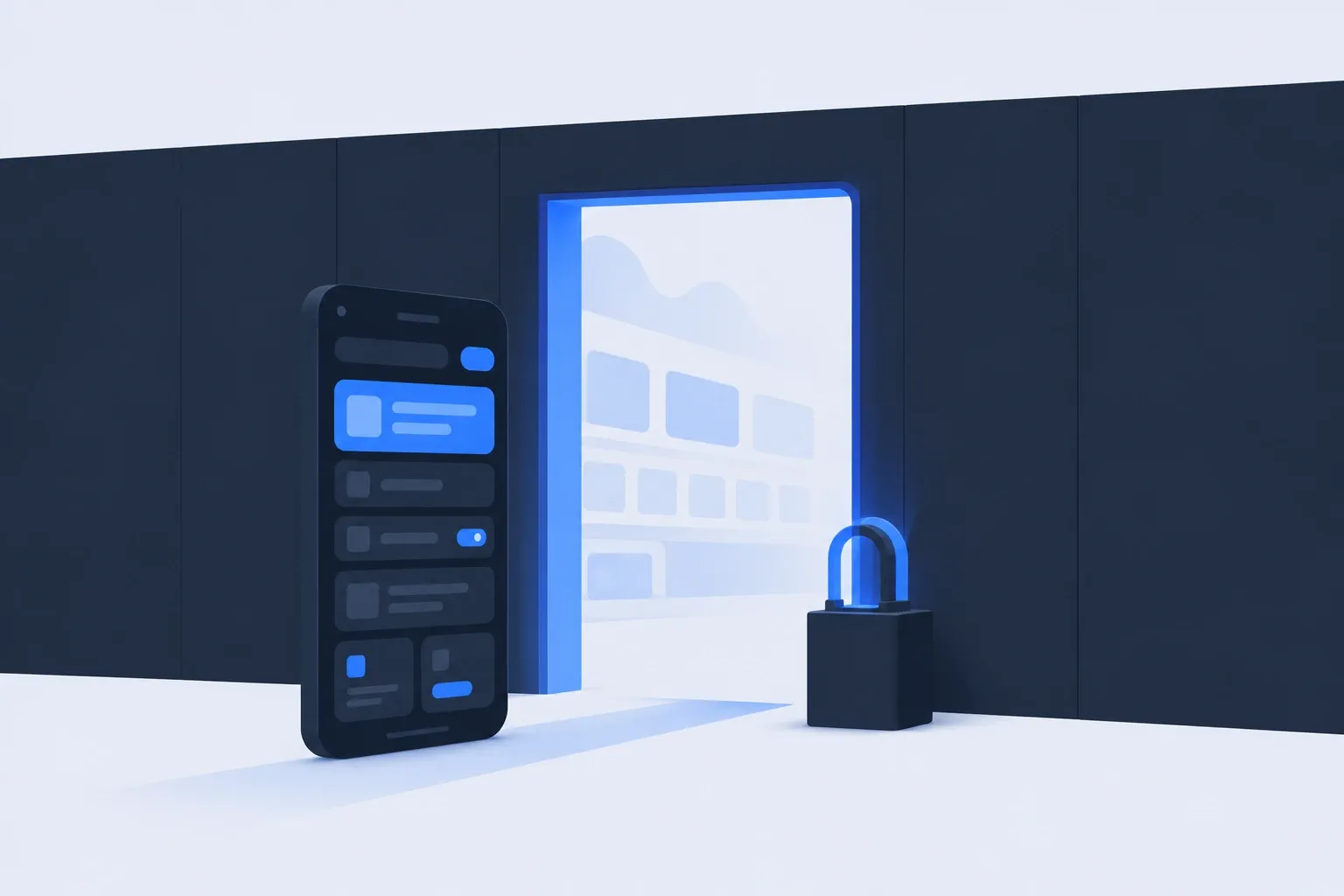
Day 1,095 — what happens to an app in the three years after you launch it.
A rule never breaks your app
Let us start with what sets this subject apart from every other in this series. When iOS or Android evolves, functions can stop responding — that is a technical problem, and it gets fixed technically. A store rule breaks nothing: your app can work perfectly, on your phone and on your users', and still be stopped at the door. Because the stores are not shelves you place an app on: they are guarded doors. Nothing reaches users without passing review, and that review applies today's rules.
It is a threat of a different nature. It does not show up as a malfunction, but as a rejection, a new requirement, a box to fill in that did not exist last time. And it comes with a language of its own — lawyers and developers mixed together — in which you would first have to work out whether you are concerned before even knowing what to do.
What the rules look at — and it is not just your code
Look at what the stores ask for, and a pattern appears: their rules are not only about what your app does — they are just as much about what it declares, requests and shows.
What it declares. Which data it collects, for what purpose, who it shares it with, which audience it addresses. The stores demand that the listing tell the truth about the app — and that demand thickens year after year.
What it requests. A permission — location, photos, microphone — can no longer simply be taken: it has to be asked for at the right moment, for a reason you can display, and one you can justify.
What it shows. Content, purchases, prices: what the app offers has to match what is announced, and stay within what the store agrees to distribute.
Add the property that app owners often discover too late: these rules apply at the moment an update shows up. An app is examined against today's rules, not the ones it was born under. On what that does, over time, to an app nobody updates anymore, Pierre-Laurent has written the reference inventory; I will not go over it again.
What "taking care of it" means on the platform side
Since the rules speak the language of compliance more than the language of code, the platform's work does not look like repair — it looks like case law.
Following what the stores publish, and above all what they start demanding in practice: a review is run by people, and the letter of a rule does not always tell you how it will be enforced. Submitting apps continuously is how you accumulate precisely that knowledge — which phrasings pass, which declarations are expected, what triggers a question from the examiner. Then translating all of it, once, into how apps are built and presented to the stores, so that every app inherits it without ever dealing with it.
The counterpoint, in one sentence this time: if you were maintaining your app on your own, that case law would be yours to reconstruct, rejection after rejection — because that is how it gets learned when nobody has learned it before you.
And the honest note that runs through this whole series applies here more than anywhere: a review keeps its share of human judgment. The upstream work makes rejections rare on the technical and declarative side; it does not turn the exam into a formality.
The two things that stay in your hands
The full map of who handles what is in the first article; for store rules it comes down to two lines — but those two lines are the heart of the matter, precisely because the rules talk about you.
Your developer account. Your app is published under your name — that is what makes it yours — and it is therefore you the stores address officially. That account comes up for renewal, and it is the door every update goes through.
The answers that concern your business. When a rule asks a question about your content — which data you collect, which audience you address, what you sell — the answer can only come from you. It is the logical consequence of everything above: the stores want the app to tell the truth about itself, and that truth is yours.
And if even that part weighs on you, GoodBarber Takes Care is the service where our team handles store submission for you.
The day your update shows up at the door
Here is what all of this changes, concretely. When you publish, your app sits an exam whose syllabus has changed since last time — it always changes. But it does not show up alone: it arrives built and presented to what the stores require that day, carried by the experience of every submission that came before yours. You did not study; the app arrives prepared. Prepared, however, is not pre-approved: the decision at the door belongs to Apple and Google, and to no one else — no platform can promise it on their behalf, and none should. What preparation changes is everything that depends on preparation; the decision itself is precisely what the review is for.
Store rules will keep changing at the same pace, and tightening in the same direction. The difference is not that they spare you — it is that they stop being your evening reading.
For the engineering version — what three years of rules and systems actually do to an app — I have told the full story on dev.to. And if your app does not exist yet, you might as well build it where someone already does that reading for you: create my app with GoodBarber.
Frequently asked questions
How do I know whether a new Apple or Google rule concerns my app?
You do not have to work it out yourself. Technical and declarative rules are tracked and applied at the platform level, without involving you. The ones that ask a question about your content or your data practices show up in your developer account, as a declaration to confirm — and there, the answer belongs to your business, not to the technology.
Can a rule change get my update rejected?
A rejection always remains possible: a review is run by people, with a share of human judgment. What the platform changes is the preparation: your app shows up built to the requirements in force, carried by the experience of previous submissions. And if the submission itself weighs on you, GoodBarber Takes Care exists to take it over.
Do I need to read Apple's and Google's guidelines before publishing?
Not for the technical and declarative side — it is tracked upstream, for every app on the platform. The rules about the content itself, on the other hand — what your app is allowed to offer, sell and show — speak about your business, and that is a domain where you remain the best placed.
Can my app be blocked even though it works perfectly?
Yes, and that is what makes store rules peculiar: they are not only about whether the app works well — they are also about its right to be distributed, meaning what it declares, requests and shows. That is why compliance is a job in its own right, distinct from the technical one: an app can be technically flawless and still be asked for a declaration that did not exist last year.


