 eCommerce
 Memberships
 RAG Chatbot
 Online Courses
 Bookings
 Travel guide
 Events
 Content Creators
 Pickup & Delivery
 Newspaper
 Radio
Radio Schools
 Faith
Faith Organizations
 Restaurant
 Grocery
 Custom apps
 Employee Communication

 NO CODE APP BUILDER
 TECHNOLOGY
 WHY GOODBARBER?
 Design
 PRODUCT RESOURCES
 TOPICS
 MOBILE APPS RESELLERS
 DISCOVER
Mobile app content strategy: what to publish, how often and what to measure
Written by Marc Leonardi on
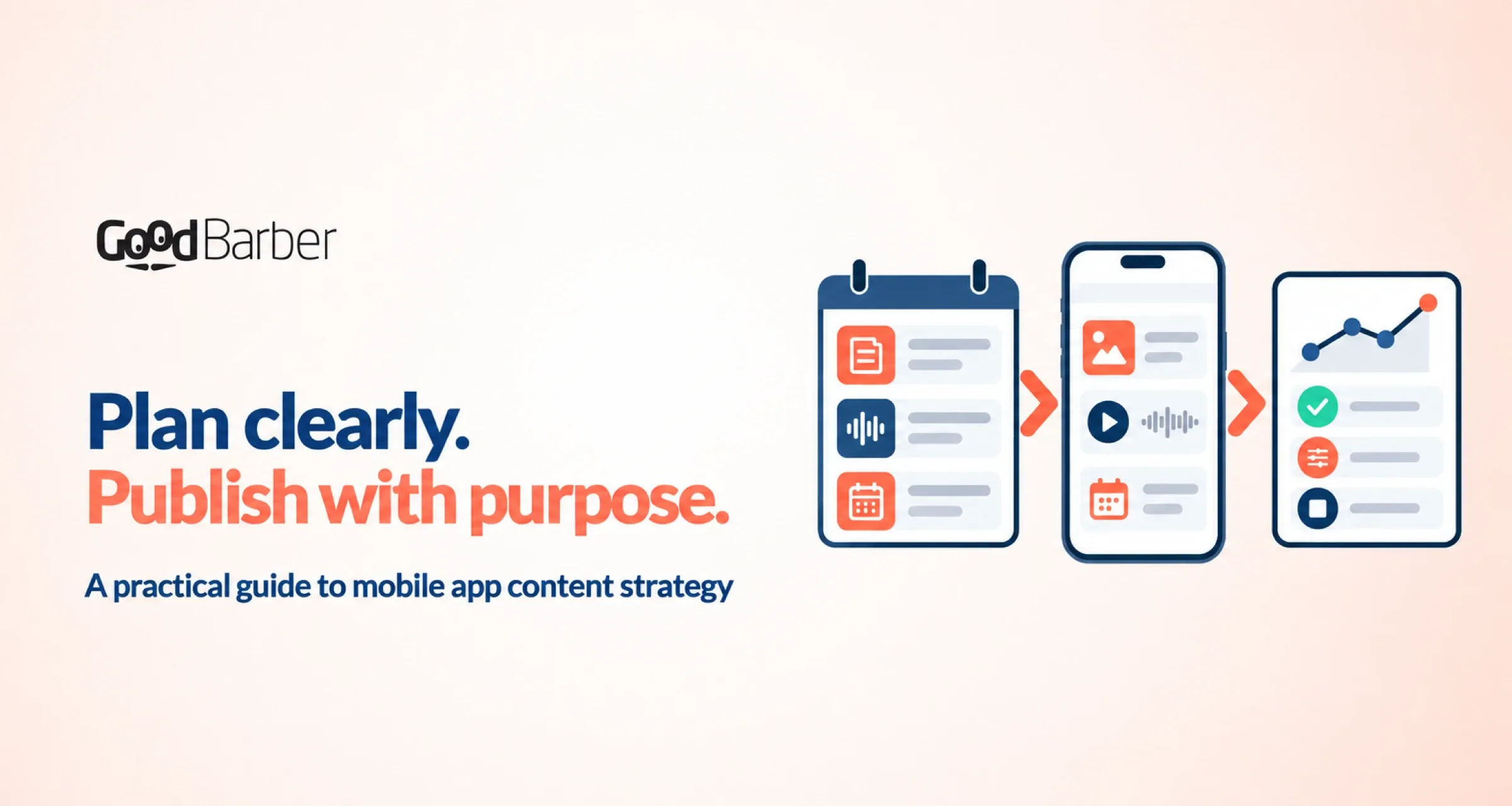
Publishing more will not rescue an app whose content has no clear job. A useful mobile app content strategy connects every recurring publication to an audience need, a distribution choice and a decision rule. This guide shows how to build that system without turning your editorial calendar into an unsustainable production line.
What is a mobile app content strategy?
Imagine a professional association that publishes a news item whenever someone has time: three updates during conference week, then silence for a month. Members cannot predict what the app will help them do. The editorial team cannot tell which work deserves to continue.
A mobile app content strategy defines the result content should produce, the recurring needs it will answer, the formats and rhythm the team can sustain, how publications will be distributed and which available signals will lead to a decision.
This guide is about the content published and consumed inside a mobile app—not content marketing used to promote an app. Store screenshots, acquisition campaigns and social posts may bring people in. The strategy here begins after they arrive.
A calendar is only the visible output. The strategy is the reasoning that decides what earns a place on it.
Start with the result the content should produce
“Keep users engaged” is too broad to guide an editor. Replace it with a result that connects an audience need to the app’s purpose.
| Intended result | Recurring audience need | Possible content response |
|---|---|---|
| Build an information habit | Know what changed and why it matters | A concise daily or weekly briefing |
| Teach a skill | Make progress through a subject | A structured series of practical lessons |
| Mobilize a community | Know what is happening and how to participate | An event, preparation note and recap |
| Support local discovery | Find useful information about a place | Curated map points and practical guides |
| Strengthen a paid offer | Receive continuing value worth returning for | A reliable premium publication or audio series |
Choose one primary result for the content system. An association app might help members act on industry changes; a tourism app might support confident local discovery. Both can publish articles, audio and events, but the same formats serve different jobs.
The result also determines what not to publish. An interview can be interesting and still have no place in a practical briefing app. Editorial discipline starts with a useful refusal.
Turn recurring needs into three or four content pillars
A content pillar is a subject the audience needs repeatedly and the team can credibly maintain. It is not a one-off campaign theme or a label broad enough to contain anything.
For the professional association, four pillars might be:
- What changed: short explanations of regulatory or market news.
- How to apply it: checklists, examples and practical lessons.
- What is happening: events, deadlines and opportunities.
- What members learned: interviews and field reports.
Keep a pillar only if it answers a recurring need, supports the app’s primary result and can be produced with enough authority to remain useful.
Three strong pillars are more valuable than ten categories that receive occasional updates. Categories organize a library; pillars organize an editorial promise.
Give each pillar a format and a sustainable cadence
Choose a format because it helps the audience use the information—not because the CMS makes it available.
| Content job | Format that may fit | Why |
|---|---|---|
| Explain a change | Short article | Easy to scan, update and reference later |
| Demonstrate a process | Video or illustrated article | Shows steps that prose alone may obscure |
| Teach during travel or exercise | Podcast or audio lesson | Can be consumed away from the screen |
| Organize a dated activity | Event | Keeps time, place and practical details together |
| Guide people through locations | Map points | Connects information to physical context |
| Show a visual result | Photo gallery | Lets the evidence carry more of the explanation |
The same idea does not need to become every format. A recorded interview might produce one edited episode and a short written summary. That is reuse with a purpose; duplicating it across every surface is not.
Next, define the minimum rhythm the team can keep during an ordinary month. Daily publishing can make sense for a newsroom with a daily promise. A specialist publisher may create more value with one dependable analysis each week. There is no universal frequency that compensates for weak relevance.
Build the calendar in layers: anchor content that fulfills the recurring promise, utility content people can return to, timely content whose value depends on a date and less frequent, in-depth content.
If the rhythm fails as soon as work becomes busy, it is not yet a strategy. Reduce the promise before lowering the quality.
Connect each publication to one useful next action
Decide what the reader can reasonably do next. A regulatory briefing might lead to a practical checklist; an event can lead to preparation details; a map point can lead to another stop nearby.
Keep the action proportionate. One article does not need to ask the reader to subscribe, register, comment, share and enable notifications at once.
In a GoodBarber Content App, links to related content, Home page widgets, categories, Search, Favorites and comments can support these continuations. Add them when they shorten the route to the next useful step.
Separate publication from distribution
Publishing makes content available. Distribution decides how people encounter it. Those are different editorial decisions.
A new item can appear in its section, be highlighted on the Home page, surface through Search or be announced through a notification. The choice depends on urgency, audience and useful lifetime.
| Situation | Appropriate starting point |
|---|---|
| Important and time-sensitive for most readers | Home highlight and a targeted or broad notification |
| Useful to a defined audience | Relevant section plus a targeted notification when the audience can be identified |
| Evergreen reference material | Category, Search and contextual links from related content |
| Predictable recurring publication | Stable placement, with selective notification rules |
| Minor update to existing information | Update the content without necessarily interrupting the audience |
Publishing frequency and notification frequency are not the same thing. An app can publish every day without sending a push every day. Notifications should be reserved for content whose timing and relevance justify an interruption.
GoodBarber supports manual and scheduled push notifications. The Automatic Push extension can create a dispatch rule when new content is published in a selected section. Automatic Push is available for Content Apps from the Premium plan. It can be configured for both native apps and PWAs.
Automation removes a repetitive action; it does not decide whether every publication deserves one. Configure it only for sections whose editorial promise supports it.
Choose signals that lead to a decision
The measurement plan should be as realistic as the publishing plan. A dashboard signal is useful only when the team knows what it could change.
GoodBarber’s internal statistics provide a directional view of sessions, unique sessions, page views, visit duration and the most active days. They show broad changes across comparable periods, not clean attribution to a particular format or a content-completion funnel.
Push statistics answer a narrower question. For each notification, GoodBarber reports the number sent, openings, click rate, expected performance based on previous campaigns and openings by hour. An opening or click shows that the notification attracted a response; it does not prove that the destination was read completely or produced the intended outcome.
For event-level behavior, content completion or detailed journeys, connect an external analytics tool suited to the question. The mobile app analytics guide explains where built-in statistics end and additional instrumentation begins.
Define the review period and decision condition before publishing. The examples below illustrate the logic, not universal thresholds: each team must choose what change is meaningful for its audience and production cost.
| Objective | Pillar | Format and cadence | Distribution | Available signal and decision rule |
|---|---|---|---|---|
| Build an information habit | Weekly briefing | Short article every Monday | Stable Home placement; selective push | Compare sessions, unique sessions and page views across equivalent periods; continue for another review cycle if the selected signals remain stable or improve under comparable distribution |
| Teach a skill | Practical lessons | Weekly article or audio | Dedicated category; occasional series announcement | Use traffic and visit-duration trends for direction; use external analytics if lesson-level completion matters |
| Mobilize members | Community actions | Event plus preparation note and recap | Agenda, Home and scheduled push | Keep the timing and message pattern if clicks remain consistent with recent comparable pushes; modify them after repeated underperformance, and measure participation only through a recorded source |
| Support discovery | Local recommendations | Curated map additions twice monthly | Map and contextual Home highlights | Watch overall usage trends; use external analytics if point-level attribution is required |
Before acting on a change, check whether the period, audience, placement and distribution were comparable. Then choose one response: continue, modify or stop.
Execute the content system with GoodBarber
The integrated CMS supports articles, videos, podcasts, photos, events and map points. Editors can organize them into sections and categories, schedule them and update them without resubmitting the app to the stores. The existing guide to the GoodBarber CMS covers those production features in detail.
The Home page can give the pillars a visible hierarchy, while Search and related navigation keep the library useful after an item leaves it.
GoodBarber’s AI Assistant can support drafting, reformulation and translation inside the editorial workflow. The subject, evidence, editorial judgment and approval remain the publisher’s responsibility.
The GoodBarber MCP server can also create, update and schedule CMS content and prepare related notifications through an AI assistant. It remains an execution layer for a strategy the publisher has already approved. The article on running an app’s editorial calendar with an agent shows that workflow separately.
The product makes the system easier to run. The publisher still decides which promise matters and which publication deserves an interruption.
Run a short editorial review
At an interval that matches the publishing cadence, compare equivalent periods and make one decision for each pillar:
- Continue: the need remains important and the format is earning sustained attention.
- Modify: the need is valid, but the format, placement, cadence or distribution may be wrong.
- Stop: the content no longer supports the primary result or cannot be produced credibly.
Record why, then change one major variable at a time. If subject, format, placement and notification all change together, the next review will not explain what helped.
Mobile app content strategy checklist
- The system has one primary result and credible pillars.
- Each pillar has a suitable primary format.
- The minimum cadence remains realistic during a normal busy period.
- Each publication offers one useful next action.
- Home placement and section organization reflect the editorial priorities.
- Publication and notification decisions are made separately.
- Automatic Push is limited to sections where every new item justifies it.
- Every metric is connected to a decision and treated as directional where attribution is unavailable.
- External analytics are added only for questions that require them.
- Each review ends with a continue, modify or stop decision.
A strong strategy does not maximize the amount of content. It creates a promise the audience can recognize and a system the publisher can keep.
FAQ
What is a mobile app content strategy?
A mobile app content strategy defines what the app will publish, which recurring audience needs it will serve, which formats and cadence it will use, how content will be distributed and what evidence will lead to an editorial decision. It concerns content consumed inside the app, not marketing content used to acquire app users.
How often should a mobile app publish new content?
Publish at the minimum reliable rhythm required by the app’s promise. A daily briefing may need daily updates, while a specialist learning app may create more value with one strong weekly lesson. Consistency and relevance matter more than copying a universal frequency.
What types of content can a mobile app publish?
A content app may combine articles, audio, video, photos, events and map-based information. Choose each format according to the task: explain, demonstrate, teach, organize something dated, support local discovery or show visual evidence.
Should every new publication send a push notification?
No. Publishing makes content available; a push interrupts the audience to announce it. Send or automate notifications only when the content’s importance, timing and audience justify that interruption.
How does GoodBarber support a mobile app content strategy?
GoodBarber brings multiple content formats, scheduling, organization, Home page presentation, Search, notifications and directional traffic statistics into one back office. Its AI Assistant and MCP server can also help execute an editorial plan after the publisher has defined and approved it.