 eCommerce
 Memberships
 Chatbot
 Online Courses
 Bookings
 Travel guide
 Events
 Content Creators
 Pickup & Delivery
 Newspaper
 Radio
Radio Schools
 Faith
Faith Organizations
 Restaurant
 Grocery
 Custom apps
 Employee Communication

 NO CODE APP BUILDER
 TECHNOLOGY
 WHY GOODBARBER?
 Design
 PRODUCT RESOURCES
 TOPICS
 MOBILE APPS RESELLERS
 DISCOVER

Travel time through the ages
 Built by GoodBarber
Your users see what a journey was worth before the car
Your user enters a distance, in kilometers or in miles, and the section answers with five durations: on foot, on horseback, by carriage, under sail and by car. Each line carries its reference pace and the time computed, in days, hours and minutes. All five recalculate at every keystroke, with no button to press. Over a hundred kilometers, that gives twenty hours of walking, two and a half days on horseback, thirteen hours of sailing, and a little over an hour by car.
The figures hold up. Switching to miles does not just change the label, it converts the distance and recalculates the five lines. A distance of zero or below shows no result: the section says so and leaves five dashes, rather than a wrong figure. And a journey too short to take a minute is shown as such, instead of zero.
A historic site, a museum, a tourist office, a hiking app: wherever a road has a history, distance stops being a number. Twenty kilometers means nothing to anyone. Four hours of walking does.
 No distance to plan for, the section computes them all
- Switching to miles recalculates everything, not just the label
- The “that took a while back then” becomes a figure
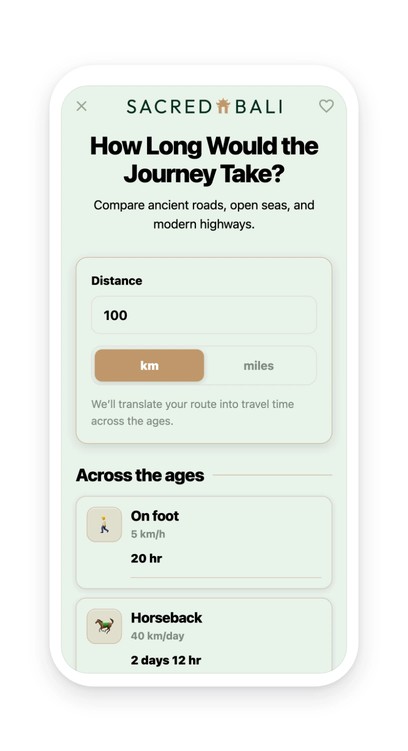
Your section lives in your app
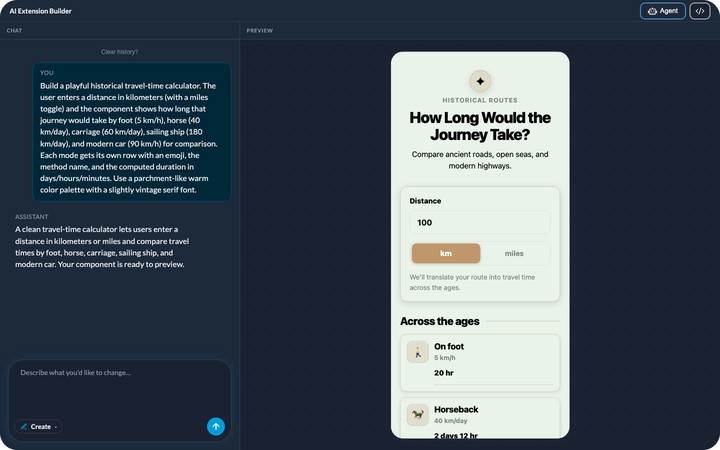
You describe it, the agent builds it, and it shows up in your app's menu. It picks up your app's colors with nothing to set, like any other section. You can rename it, move it in the menu, change its design.
And it keeps evolving with you: ask for a change in plain language, or edit the generated code directly.


