 eCommerce
 Memberships
 RAG Chatbot
 Online Courses
 Bookings
 Travel guide
 Events
 Content Creators
 Pickup & Delivery
 Newspaper
 Radio
Radio Schools
 Faith
Faith Organizations
 Restaurant
 Grocery
 Custom apps
 Employee Communication
 NO CODE APP BUILDER
 TECHNOLOGY
 WHY GOODBARBER?
 Design
 PRODUCT RESOURCES
 TOPICS
 MOBILE APPS RESELLERS
 DISCOVER
10 Best AI App Builders in 2026
Scored on two things that actually matter: how good the AI generation is and whether you get a real, shippable app or just a prototype.
The short answer
An AI app builder turns a plain-English prompt into a working app. In 2026 the label hides two very different products: tools that are brilliant at generating code but stop at a web prototype, and tools that generate less on their own but hand you a real, shippable app. The winner depends on which half of that gap you care about.
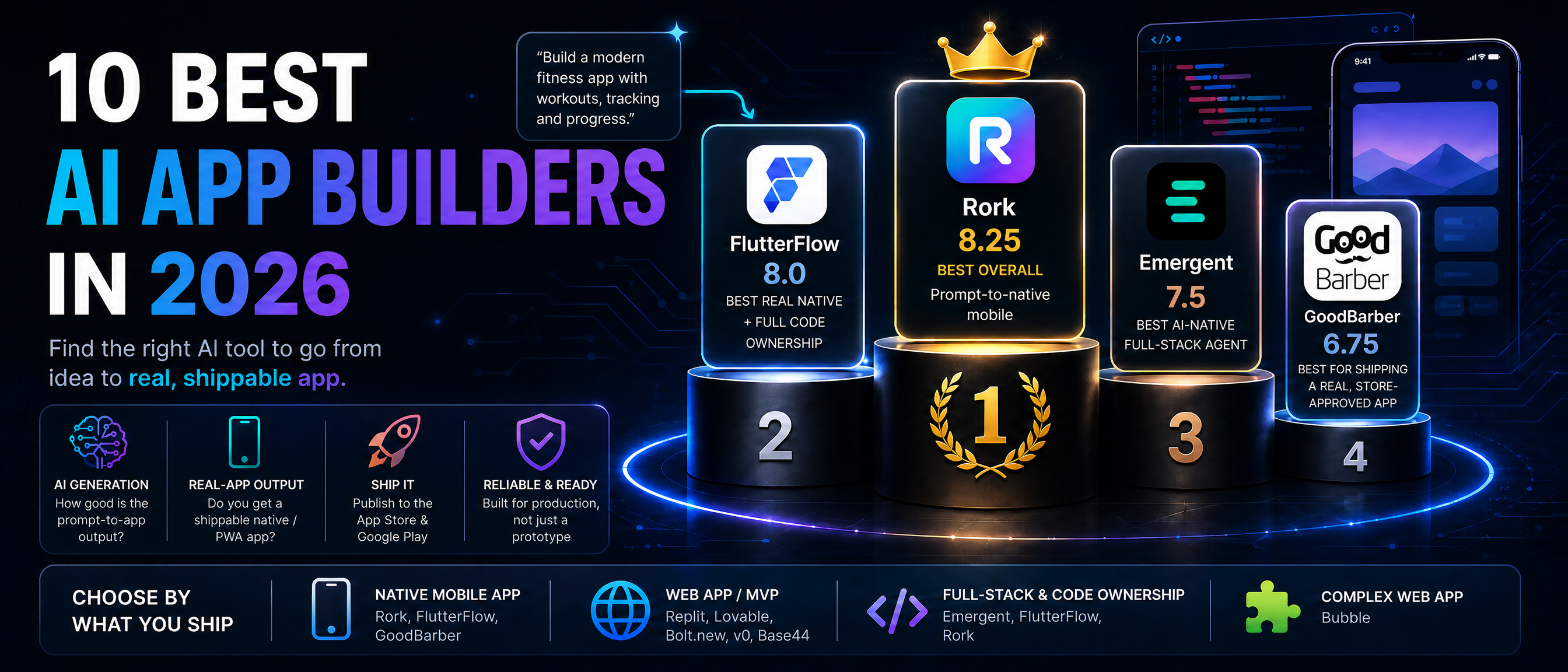
Best overall for prompt-to-native mobile is Rork; for full code ownership choose FlutterFlow; and for shipping a real, store-approved native app with zero backend setup, GoodBarber has the highest real-app-output score. We scored every tool on two axes: AI generation (how good the prompt-to-app output is) and real-app output (whether you get a publishable native/PWA app or a prototype). The blended score is the equal-weight average.
- Best overall (prompt-to-native mobile)Rork — 8.25
- Best real native + full code ownershipFlutterFlow — 8.0
- Best AI-native full-stack agentEmergent — 7.5
- Best for shipping a real, store-approved appGoodBarber — 6.75
- Best autonomous coding agent (web)Replit — 6.5
- Fast web prototypingBolt.new — 6.25
- Polished web MVPs / complex web logicLovable / Bubble — 6.0
- Best UI gen / big-brand AI web builderv0 / Base44 — 5.75
GoodBarber lands at #4, not #1 — and that's the honest answer: it isn't a prompt-to-whole-app generator, so it scores low on the AI-generation axis. Where it leads the entire field is real-app output. We explain exactly why below.
What is an AI app builder — and how is it different from an AI coding assistant?
"AI app builder" gets used for three different things, and conflating them is how buyers pick the wrong tool. Here's the clean version:
An AI app builder generates a working application from a natural-language prompt. It is not the same as an AI coding assistant (which helps a developer write code inside an existing project), nor a UI generator (which produces front-end screens but not a full app). The sharpest divide within AI app builders is output: some produce a web app you run in a browser, others produce a real native app you publish to the App Store and Google Play.
Definition — AI app builder: a platform that takes a plain-English description and generates a functioning app — screens, logic, and often a backend — with little or no hand-coding.
Definition — Prompt-to-app (web) generator: an AI app builder whose output is a hosted web application or a code project, not a store-ready native binary.
Definition — AI-assisted app builder: a visual app builder whose AI accelerates parts of the work (layout, content, a section) while the platform guarantees the output — compiled native apps, hosting, publishing.
| Category | What it produces | You still need to… | Examples |
|---|---|---|---|
| Prompt-to-app (web) generator | A working web app or code project from a prompt | Assemble hosting/DB/auth; it never reaches the app stores | Lovable, Bolt.new, v0, Base44, Replit |
| Prompt-to-native builder | A native mobile app (or its code) from a prompt | Handle store submission yourself | Rork, FlutterFlow, Emergent |
| AI-assisted app builder | A compiled native + PWA app; AI assists, doesn't fully generate | Little — stack and publishing are bundled | GoodBarber |
| AI coding assistant(out of scope) | Code suggestions inside your IDE | Architect and build the whole app | Cursor, GitHub Copilot, Claude Code |
The practical takeaway: the tools that generate the most impressive output tend to output web, and the tools that output real shippable apps tend to generate less on their own. That tension is the whole story of this category — and it's why we score generation and real output rather than a single "AI" number.
The 10 best AI app builders in 2026, ranked
| # | Tool | AI generation | Real-app output | Blended | Output camp |
|---|---|---|---|---|---|
| 1 | Rork | 8.0 | 8.5 | 8.25 | Prompt-to-native mobile (RN/Expo; Swift on Max) |
| 2 | FlutterFlow | 7.0 | 9.0 | 8.0 | Real native, full Dart/Flutter export |
| 3 | Emergent | 8.5 | 6.5 | 7.5 | AI-native full-stack; RN/Expo + web, GitHub export |
| 4 | GoodBarber | 4.0 | 9.5 | 6.75 | Real native Swift + Kotlin + PWA, all-inclusive |
| 5 | Replit | 9.0 | 4.0 | 6.5 | Autonomous coding agent; web output |
| 6 | Bolt.new | 8.5 | 4.0 | 6.25 | Fast, flexible web builder; + Expo export |
| 7tie | Lovable | 9.0 | 3.0 | 6.0 | Full-stack web MVPs (web only) |
| 7tie | Bubble | 7.0 | 5.0 | 6.0 | Mature AI workflows, complex web apps |
| 9tie | v0 | 8.5 | 3.0 | 5.75 | UI generation, Next.js-locked |
| 9tie | Base44 | 8.0 | 3.5 | 5.75 | Wix-owned AI web builder |
How to read this table: a high AI generation score means the tool is great at turning a prompt into something usable. A high real-app output score means what it turns out is something you can actually publish and run in production — a native app in the App Store and Google Play, or a real installable PWA — rather than a web prototype. The blended score is the equal-weight average; the right tool for you depends on which axis you weight more.
Best for — decision matrix
| If you need to ship… | Start with |
|---|---|
| A native mobile MVP from a prompt | Rork |
| A real native app you fully own in code | FlutterFlow |
| A full-stack app you'll own on GitHub | Emergent |
| A real, store-approved native + PWA product with no stack to assemble | GoodBarber |
| A web app or internal tool via an agent | Replit |
| A fast web prototype | Bolt.new |
| A polished full-stack web MVP | Lovable |
| A complex, logic-heavy web app | Bubble |
| Production-quality UI | v0 |
| An AI web builder inside a large ecosystem | Base44 |
Specs at a glance
| Tool | Output | Pricing model | Starting price | Native output | Store publishing |
|---|---|---|---|---|---|
| Rork | RN/Expo (Swift on Max) | Message-based subscription | Pro / Max tiers | ✓ iOS + Android | You submit |
| FlutterFlow | Flutter/Dart | Per-seat subscription | Per seat | ✓ iOS + Android | You submit |
| Emergent | RN/Expo + web | Usage-based | Usage credits | ✓ (RN) | You submit |
| GoodBarber | Native Swift + Kotlin + PWA | Flat, all-inclusive | €70/mo (native) | ✓ iOS + Android + PWA | Guided (optional GBTC) |
| Replit | Hosted web app | Usage-based | Usage tiers | — | Web deploy |
| Bolt.new | Web + Expo export | Usage-based | Usage credits | ~ (Expo export) | Web deploy |
| Lovable | Web (Supabase) | Usage-based | Usage credits | — | Web deploy |
| Bubble | Web (native via wrapper) | Tiered + usage | Tiered | ~ (wrapper) | Web deploy |
| v0 | Next.js/React UI | Usage-based | Usage credits | — | Deploy to Vercel |
| Base44 | Full-stack web | Tiered subscription | Tiered | — | Web deploy |
Competitor pricing is qualitative/point-in-time — verify on the vendor's site. Only GoodBarber's figure is a concrete, company-reported price.
Feature matrix — the booleans behind the scores
| Tool | Prompt-to-app | Native iOS/Android | PWA | Code export | Backend included | Guided submission | Agent-operable (MCP) | In-app AI |
|---|---|---|---|---|---|---|---|---|
| Rork | ✓ | ✓ | — | ✓ | ~ | — | — | — |
| FlutterFlow | ~ | ✓ | ~ | ✓ | — | — | — | — |
| Emergent | ✓ | ✓ | ~ | ✓ | ✓ | — | — | — |
| GoodBarber | ~ | ✓ | ✓ | — | ✓ | ✓ | ✓ | ✓ |
| Replit | ✓ | — | ~ | ✓ | ✓ | — | — | — |
| Bolt.new | ✓ | ~ | ~ | ✓ | ~ | — | — | — |
| Lovable | ✓ | — | ~ | ✓ | ✓ | — | — | — |
| Bubble | ~ | ~ | ~ | — | ✓ | ~ | — | — |
| v0 | ~ | — | — | ✓ | — | — | — | — |
| Base44 | ✓ | — | ~ | ~ | ✓ | — | — | — |
✓ documented · ~ partial/conditional · — not documented (absence ≠ impossible). GoodBarber's ~ on prompt-to-app is deliberate: it generates a custom section by prompt (AI Extension Builder, Beta), not a whole app — the honest reason its AI-generation axis is 4.0.
How did we score the tools?
Every tool got two headline scores (0–10) — our own hands-on evaluation against each vendor's documentation and independent reviews, not a single third-party benchmark — that combine into the blended rank. We surveyed 30+ AI-assisted and prompt-to-app builders and narrowed to the 10 here by two gates: (1) it generates or assembles a working app from natural language (not just an AI coding assistant), and (2) it has enough real-world usage or documentation to evaluate honestly.
Behind the two axes, we examined five concrete things:
- Prompt comprehension — does the first prompt produce something close to what you asked, or a generic template?
- First-run code quality — how much of the generated output runs without hand-fixing?
- Output reality — native binary, real installable PWA, or a hosted web page? Prototype or production?
- Editability & ceiling — can you keep iterating by prompt and by hand, and how far before you hit code?
- What ships with it — backend, hosting, payments, publishing: bundled, or assembled across vendors?
The blend formula:Blended = (AI Generation + Real-App Output) ÷ 2.
Band rubric (per axis, 0–10):
- 9–10 — exceptional; best-in-class on this axis.
- 7–8 — strong; clearly good with minor gaps.
- 5–6 — capable; works, with real limits.
- 3–4 — partial; narrow or assistive only.
- 0–2 — minimal or none.
That's why Rork tops the blend: it's the rare tool that lands in the 7–8 band on both axes. GoodBarber sits at 9.5 on real-app output (exceptional) but 4.0 on AI generation (partial — assistive, not prompt-to-app), which is exactly the trade-off the two-axis model is built to show.
One honest note up front: the tools that claim the most AI magic don't always deliver a shippable result. A flawless web prototype is still not an app in the stores. That tension is the whole story of this category — and it's why we score generation and real output, not a single "AI" figure.
The prototype-to-production gap: what it really costs to ship a generated app
The demo is the easy part. The gap between "the AI generated a working app" and "customers can download it" is where most prompt-to-app projects stall — and it's the dimension that most separates this field. It has two components, and both are quantifiable.
1. The stack tax. Even the full-stack web generators that give you a real working app (Lovable, Bolt.new, Base44) hand you an app that still needs a production stack assembled around it — and none of them reach the app stores. Here's the shape of the monthly bill, with every competitor figure clearly marked as an illustrative assumption:
| Production layer | Assemble-it-yourself (web generators) | GoodBarber (all-inclusive) |
|---|---|---|
| Builder plan | Generator subscription / credits | Included |
| Hosting | assume ~$20/mo | Included |
| Database + auth | assume Supabase/Firebase ~$25/mo | Included |
| Payments | Processor fees (usage) | Included · 0% GoodBarber commission (processor fees apply) |
| Push notifications | assume ~$10/mo | Included |
| Analytics | assume ~$10/mo | Included |
| Native builds + store submission | Not available from a web generator | Included (guided) |
| Result | Multiple vendors, variable bill, web only | One flat subscription from €70/mo, native + PWA |
The dollar figures above are illustrative assumptions, not vendor quotes — the point is the shape: a web generator's true cost is its subscription plus a stack you assemble and maintain, and it still can't publish to the stores. GoodBarber's real, company-reported price folds hosting, database, CMS, push, e-commerce, and analytics into one subscription.
2. The App Store gate. For the native-capable tools, the last mile is Apple review. Apple rejects roughly 42% of first submissions (Apple's own guidelines list common failures such as §4.2 Minimum Functionality). A tool that generates a great prototype but leaves you to fight that gate alone has done the easy 80%. GoodBarber's managed publishing service reports getting 91% of first-submission rejections ultimately accepted — the difference between a working demo and a live listing.
The 10 tools, in detail
1. Rork — best overall for prompt-to-native mobile
Best for: founders who want a real native mobile MVP from a plain-English prompt.
Rork — ranked #1 (blended 8.25/10; AI generation 8.0, real-app output 8.5). A prompt-to-native mobile app builder that generates a working React Native / Expo project from a plain-English prompt — with native Swift on the Max plan — the rare AI tool that targets real mobile from the first prompt.
Rork is the one AI builder here that aims at mobile from the first prompt instead of generating a web app you later try to wrap. Describe your app and it produces a working React Native / Expo project; on the Max plan it can produce native Swift. Generation is strong (8.0), and — crucially — what comes out is a genuine mobile app project you can keep pushing toward the stores (8.5). You iterate by prompt, then drop into the Expo/RN code when you need to. Independent reviews confirm its native-mobile focus. Nothing else in the set blends generation and real output as well; the honest limitation is that the last mile to the App Store is still yours to walk.
- Category
- Prompt-to-native mobile builder
- Pricing model
- Message-based subscription (Pro / Max tiers)
- Starting price
- Pro / Max tiers (verify on vendor site)
- Native output
- React Native / Expo · native Swift on Max
- Store publishing
- You submit
- Best for
- Prompt-to-native mobile MVPs
- Main limitation
- Store submission and native edge cases are on you
- Evidence
- docs.rork.com · NoCode.MBA
2. FlutterFlow — best real native apps with full code ownership
Best for: teams that want AI acceleration without giving up native output or their code.
FlutterFlow — ranked #2 (blended 8.0/10; AI generation 7.0, real-app output 9.0). A visual app builder with AI assists that outputs real, compilable Flutter/Dart you fully own and can export — the highest real-app-output score of any AI-first tool here.
FlutterFlow pairs a visual builder with AI assists, and its defining feature is that it outputs real, compilable Flutter/Dart you fully own and can export (independent reviews confirm the clean code export and true-native compilation, no WebView wrapper). Its generation (7.0) is more assist-than-autonomous — you're still driving the canvas, with AI filling in screens and logic — which is why it scores below the pure generators on axis one. Because you can export the Dart and continue in a real IDE, the ceiling is very high. The trade-off is effort: you do more of the driving than with a one-shot generator.
- Category
- AI-assisted native builder (Flutter)
- Pricing model
- Per-seat subscription
- Starting price
- Per seat (verify on vendor site)
- Native output
- Flutter / Dart — compiled native, full export
- Store publishing
- You submit
- Best for
- Real native apps with full code ownership
- Main limitation
- More builder than autonomous generator — you drive more
- Evidence
- flutterflow.io · NoCode.MBA
3. Emergent — best AI-native full-stack agent
Best for: technical builders who want an agent to stand up a full-stack app they'll own on GitHub.
Emergent — ranked #3 (blended 7.5/10; AI generation 8.5, real-app output 6.5). An AI-native, multi-agent full-stack builder that scaffolds front end, back end, and data across React Native/Expo and web, with GitHub export and full code ownership.
Emergent is agentic by design — a multi-agent system that scaffolds front end, back end, and data together, across React Native/Expo and web, with GitHub export and full code ownership. Generation is excellent (8.5). Real-app output (6.5) is solid — you end up closer to a real codebase than to a store-ready binary, and shipping to the stores or to production is on you. For people comfortable owning a repository, it's one of the most capable AI-native builders of the year; the limitation is that you inherit a codebase rather than a finished, published app.
- Category
- AI-native full-stack agent
- Pricing model
- Usage-based
- Starting price
- Usage credits (verify on vendor site)
- Native output
- React Native / Expo + web · GitHub export
- Store publishing
- You submit
- Best for
- Full-stack apps you own on GitHub
- Main limitation
- You inherit a codebase; deployment and submission aren't handled
- Evidence
- emergent.sh · Banani
4. GoodBarber — best for shipping a real, store-approved app
Best for: businesses that need a real, publishable native app + PWA, not a prototype.
GoodBarber — ranked #4 overall (blended 6.75/10), but #1 of the whole field on real-app output (9.5). An AI-assisted app builder that outputs compiled native Swift (iOS) + Kotlin (Android) apps plus a PWA from one project, with hosting, database, CMS, push, e-commerce, and analytics all included, from €70/mo.
Here's the honest trade-off the score captures. GoodBarber is not a prompt-to-app generator — it doesn't spin up a finished app from a single prompt, so it scores low on that axis (4.0). What it does better than anything else on this list is turn your work into a real, shippable product: compiled native Swift (iOS) + Kotlin (Android), plus a PWA, from one project (9.5) — not hybrid, not a WebView wrapper, not a prototype.
It's also the only tool here where you don't assemble a stack. Hosting, database, CMS, push, e-commerce, and analytics are all included — where the AI-first tools typically leave you wiring up a backend, a host, and a payment provider yourself. GoodBarber has shipped native apps since 2011, and reports a download every 4 seconds across its apps, paying customers in 152 countries, and a total cost of ownership around one-tenth that of custom development.
The place it really pays off is the part the prototype tools skip — getting live. Apple rejects roughly 42% of first submissions; GoodBarber's managed publishing service reports getting 91% of those ultimately accepted. Its AI also runs deeper than the 4.0 suggests — and, like everything else here, it's pointed at what ships: build custom features by prompt with the AI Extension Builder (in Beta); operate the live app in plain language through its Model Context Protocol (MCP) server and 44 Claude Skills (agent-ready, not autonomous — you stay the operator); and embed a managed, content-grounded RAG chatbot for your own end-users. The honest boundary: it's built for content and commerce apps, not games or complex marketplaces.
- Category
- AI-assisted native + PWA builder (all-inclusive)
- Pricing model
- Flat, all-inclusive subscription
- Starting price
- Native apps from €70/mo (Premium)
- Native output
- Native Swift (iOS) + Kotlin (Android) + PWA
- Store publishing
- Guided (optional GBTC add-on)
- Best for
- Shipping a real, store-approved native + PWA app with zero backend setup
- Main limitation
- AI accelerates; it doesn't generate the whole app from a prompt · content & commerce apps, not games/marketplaces
- Evidence
- Native technology · Publishing service · AI features (GoodBarber's own reported figures)
5. Replit — best autonomous coding agent
Best for: people comfortable steering an agent toward a web app or internal tool.
Replit — ranked #5 (blended 6.5/10; AI generation 9.0, real-app output 4.0). The strongest autonomous coding agent in the set — it plans, writes, runs, and hosts a full web app in the browser as you talk to it — but its output is web, not native mobile.
Replit's Agent is the strongest autonomous agent here (9.0): it plans, writes, runs, and hosts a full app in the browser, iterating as you talk to it and deploying to a live URL in its cloud. Real-app output (4.0) is web-focused — excellent for internal tools, dashboards, and web MVPs, but not native mobile. Because it's a real coding environment underneath, the ceiling is genuinely high — though by the time you're there, you're effectively developing.
- Category
- Autonomous coding agent (web)
- Pricing model
- Usage-based tiers
- Starting price
- Usage tiers (verify on vendor site)
- Native output
- Hosted web app; no native binaries
- Store publishing
- Web deploy
- Best for
- Autonomous web app / internal-tool building
- Main limitation
- Web output, not native mobile
- Evidence
- replit.com · NoCode.MBA
6. Bolt.new — best for fast, flexible web prototyping
Best for: rapid web prototypes and quick iteration.
Bolt.new — ranked #6 (blended 6.25/10; AI generation 8.5, real-app output 4.0). From StackBlitz: generates full-stack web apps in-browser fast, with an Expo export path toward mobile — but the native path stops at the Expo dev preview.
Bolt.new generates full-stack web apps in-browser, fast, with real flexibility — and offers an Expo export path toward mobile. Generation is strong (8.5); real-app output (4.0) is web-first, so you get a working web app or a starting Expo project rather than a store-ready native build (the mobile path stops at the Expo dev preview). For speed of first draft, it's excellent.
- Category
- AI web builder (StackBlitz)
- Pricing model
- Usage-based
- Starting price
- Usage credits (verify on vendor site)
- Native output
- Web · Expo export path
- Store publishing
- Web deploy
- Best for
- Fast web prototypes
- Main limitation
- Mobile is an export path, not a native default
- Evidence
- bolt.new · Builder.io
7. Lovable — best full-stack web MVPs
Best for: founders shipping a polished web product fast.
Lovable — ranked #7 (tie) (blended 6.0/10; AI generation 9.0, real-app output 3.0). Turns a prompt into a polished full-stack web MVP with a Supabase backend and clean React/TypeScript — arguably the best generation quality in the set, but web only.
Lovable is arguably the best at turning a prompt into a polished full-stack web MVP (9.0 generation), with clean, Supabase-backed React/TypeScript apps. It's web only (3.0 real-app output) — no native mobile. If your product lives in the browser, few tools get you to a good-looking, working MVP faster.
- Category
- AI full-stack web builder
- Pricing model
- Usage-based
- Starting price
- Usage credits (verify on vendor site)
- Native output
- Web only (Supabase backend)
- Store publishing
- Web deploy
- Best for
- Polished full-stack web MVPs
- Main limitation
- No native mobile output
- Evidence
- lovable.dev · NoCode.MBA
7. Bubble — best for complex web apps
Best for: logic-heavy web applications with mature workflows.
Bubble — ranked #7 (tie) (blended 6.0/10; AI generation 7.0, real-app output 5.0). The veteran visual platform that added AI: it can draft a working web app — pages, database, workflows — from a prompt, with the deepest visual logic in the set; native is via a wrapper.
Bubble is the veteran of the category: mature visual logic, a deep plugin ecosystem, and AI that now generates workflows and layouts from prompts. Real-app output (5.0) is web-first, with heavier applications very much possible; native is via wrappers rather than true native. When your app is defined by complex logic more than by AI generation, Bubble's maturity shows — at the cost of a real learning curve.
- Category
- Visual web app builder (+ AI)
- Pricing model
- Tiered subscription + usage
- Starting price
- Tiered (verify on vendor site)
- Native output
- Web · native via wrapper
- Store publishing
- Web deploy (wrapper for stores)
- Best for
- Complex, logic-heavy web apps
- Main limitation
- Learning curve; native isn't true native
- Evidence
- bubble.io · QuantumByte
9. v0 — best UI generation
Best for: designers and developers generating production-quality UI.
v0 — ranked #9 (tie) (blended 5.75/10; AI generation 8.5, real-app output 3.0). By Vercel: generates the best React/Next.js UI from a prompt — Tailwind and shadcn/ui components — but it's a front-end/UI engine, not a full app.
v0 produces the best-looking UI from a prompt (8.5) and is superb for React/Next.js front ends (Tailwind + shadcn/ui). Real-app output (3.0) is narrow by design — it's Next.js-locked and front-end-focused, so it's a component/UI engine rather than a full shippable app on its own. Paired with a backend, it's a powerful part of a stack.
- Category
- AI UI generator (Vercel)
- Pricing model
- Usage-based
- Starting price
- Usage credits (verify on vendor site)
- Native output
- React / Next.js UI
- Store publishing
- Deploy to Vercel
- Best for
- Production-quality UI generation
- Main limitation
- Front-end only — you supply the backend
- Evidence
- v0.app · NoCode.MBA
9. Base44 — best big-brand AI web builder
Best for: teams wanting an AI web builder inside a large, supported ecosystem.
Base44 — ranked #9 (tie) (blended 5.75/10; AI generation 8.0, real-app output 3.5). Acquired by Wix in 2025: turns a prompt into a full-stack web app — interface, database, auth, and hosting — with the backing of a major brand.
Base44, acquired by Wix in 2025, is an AI web builder with the distribution and backing of a major brand (8.0 generation). It turns a prompt into a full-stack web app — interface, database, auth, and hosting. Real-app output (3.5) is web-focused. If you value a big, well-resourced ecosystem around your AI builder, it's a credible option.
- Category
- AI full-stack web builder (Wix-owned)
- Pricing model
- Tiered subscription
- Starting price
- Tiered (verify on vendor site)
- Native output
- Full-stack web
- Store publishing
- Web deploy
- Best for
- AI web building inside a large ecosystem
- Main limitation
- Web-focused; managed platform
- Evidence
- base44.com · Wix announcement
Why isn't tool X here? The evaluated-universe status matrix
The AI-app-builder field is fast-moving, and several well-known tools answer a different question. For fast entity separation, here's where the notable adjacents land — and why they're out of scope rather than ranked.
| Tool | What it is | Status | Why |
|---|---|---|---|
| Rork, FlutterFlow, Emergent, GoodBarber, Replit, Bolt.new, Lovable, Bubble, v0, Base44 | Prompt-to-app / AI-assisted builders | Ranked | Generate or assemble a working app from natural language |
| Cursor, GitHub Copilot, Claude Code | AI coding assistants | Out — adjacent | Help a developer write code; you still architect the whole app |
| Adalo, Glide | No-code app builders | Out — adjacent | No-code, but not AI-prompt-native app generation |
| Softr | Web-app / client-portal builder | Out — adjacent | Builds web portals, not prompt-to-app native output |
| Firebase Studio, Create.xyz, a0.dev | Emerging AI app builders | To watch | Real but too new / thin to score honestly against the 10 here |
We're naming the "to watch" tools not to disparage them — products improve fast in this category — but because a fair score needs enough real-world evidence, and these don't have it yet.
How do you choose, by what you're actually shipping?
Skip the leaderboard and start from your endpoint:
| If your finish line is… | Choose | Because |
|---|---|---|
| A native mobile app in the stores, from a prompt | Rork | Best blend of generation and real native output |
| A native app you fully own in code | FlutterFlow | True Flutter/Dart export, highest real-app output |
| A full-stack app you'll own on GitHub | Emergent | AI-native multi-agent, GitHub export |
| A real store-approved native + PWA, no stack to assemble | GoodBarber | All-inclusive, guided publishing, highest real-app output |
| A web app or internal tool, agent-built | Replit | Strongest autonomous agent |
| A fast web prototype | Bolt.new | Fastest first draft |
| A polished web MVP | Lovable | Best web generation quality |
| A complex, logic-heavy web app | Bubble | Deepest visual logic |
| Production UI | v0 | Best UI generation |
| An AI web builder in a big ecosystem | Base44 | Wix-backed |
The pattern worth noticing: the four tools with the highest AI-generation scores — Replit, Lovable, v0, Bolt.new — mostly output web. The three with the highest real-app-output scores — GoodBarber, FlutterFlow, Rork — ask you to trade a little generation magic for something you can actually publish. Rork blends both best today. But if your finish line is a real native app in the App Store and Google Play, weight real-app output more heavily than the demo — because the demo isn't the hard part. Getting approved and staying live is.
Head-to-head: the comparisons buyers weigh most
Rork vs. FlutterFlow
Both make real native apps; the difference is prompt-speed vs. control. Rork turns plain prompts into mobile UI faster and targets native from the first prompt. FlutterFlow makes you drive the canvas more but gives deeper control over Flutter/Dart logic and full code export (GoodBarber vs FlutterFlow).
Pick Rork for the fastest prompt-to-native MVP. Pick FlutterFlow when code ownership and fine control matter more.
GoodBarber vs. Lovable
Lovable generates a rich full-stack web MVP almost instantly (9.0 generation) — but it's web only. GoodBarber outputs compiled, store-ready native iOS/Android (plus PWA) with hosting, database, and store submission bundled in (GoodBarber vs Lovable).
Pick Lovable for the fastest polished web MVP. Pick GoodBarber when it has to ship to the stores without assembling a stack.
Replit vs. GoodBarber
Replit's agent autonomously builds and hosts a web app as you chat (9.0 generation, web output). GoodBarber assists rather than auto-generates, but its output is a real native app in the stores with the backend bundled.
Pick Replit for an agent-built web app or internal tool. Pick GoodBarber when the endpoint is a published native app.
Where GoodBarber fits (and where it doesn't)
It would be easy to put GoodBarber at #1 on GoodBarber's own blog. The score says #4, and that's the honest answer: if you want the AI to write your app from a sentence, tools higher on this list do that better today. Rork, FlutterFlow, and Emergent all beat it on the blend, and Replit, Lovable, v0, and Bolt.new all beat it on pure generation.
What GoodBarber is for is the other half of the problem — the half the prompt-to-app tools quietly leave to you. It turns your project into compiled native Swift and Kotlin apps plus a PWA, bundles the entire stack (hosting, database, CMS, push, e-commerce, analytics) into one predictable subscription, and carries you through App Store and Google Play submission — where Apple rejects roughly 42% of first tries and GoodBarber reports recovering 91% of them. It's the platform you reach for when the AI-first prototype has proven the idea and now the thing actually has to ship, perform on real devices, and stay in the stores.
Its AI works the same way — aimed at what ships, not at a demo. You can build custom sections by prompt (the AI Extension Builder, in Beta), run the live app in plain language through its MCP server and 44 Claude Skills, and even embed a content-grounded AI chatbot for your own users. It's a narrower AI surface than a pure prompt-to-app tool — but every piece of it lands inside a real, publishable app, and it removes the stack tax the generators leave behind.
And there's an honest boundary: it's built for content and commerce apps, not games or complex marketplaces. Inside that scope, since 2011, across 152 countries, at about a tenth of the cost of custom development, it's one of the most dependable ways to get a real app live.
Frequently Asked Questions
An AI app builder lets you describe an app in plain English and generates a working version — screens, logic, and often a backend — instead of building it by hand. In 2026 the term splits into two camps: tools that generate web apps/prototypes (Replit, Lovable, v0, Bolt.new, Base44) and tools that produce real native or PWA apps you can publish (Rork, FlutterFlow, GoodBarber).
By our blended score, Rork ranks first (8.25) for prompt-to-native mobile, followed by FlutterFlow (8.0) and Emergent (7.5). GoodBarber leads the field on real-app output specifically (9.5) but ranks #4 overall because its AI is assistive, not prompt-to-app.
For genuine native mobile output, look at Rork (React Native/Expo, Swift on its top plan), FlutterFlow (compilable Flutter/Dart you can export), and GoodBarber (compiled native Swift + Kotlin, plus a PWA). Most of the highest-scoring generators — Lovable, v0, Bolt.new — output web.
It can get you most of the way, but publishing is its own hurdle. Most AI builders output web apps that never touch the store. Of the native-capable tools, you still have to clear Apple review — which rejects roughly 42% of first submissions. Platforms with a guided submission path (GoodBarber reports recovering 91% of first-submission rejections) reduce that risk; pure generators leave it to you.
If you want the least code and a real app at the end, GoodBarber (visual builder, AI assists, everything bundled, guided publishing) is the gentlest path to a shippable native app. If you want the AI to do more of the building and you're comfortable iterating by prompt, Rork (mobile) or Lovable (web) are approachable.
Yes — the 4.0 just reflects that it doesn't build a whole app from one prompt. GoodBarber's AI is aimed at what ships: Genius Palette (a free, in-house-trained model for app colour palettes) plus one-click AI writing, SEO, and translation; an AI Extension Builder (in Beta) that turns a prompt into a custom app section wired to the platform's APIs; agent-ready operation of the live app via its MCP server and 44 Claude Skills; and a managed, content-grounded RAG chatbot you can embed for your own users. It's a narrower, ship-focused AI surface — not a prompt-to-whole-app generator.
It varies. Emergent exports to GitHub, FlutterFlow exports Dart, and Rork/Bolt.new give you an Expo project — so you keep the code. GoodBarber isn't code-export, but it maintains, hosts, and ships the app for you as an all-inclusive platform. Web generators like v0 and Lovable give you their output but tie you to their stack (Next.js, Supabase).
Most offer a free tier or trial credits to test generation — Replit, Bolt.new, v0, Lovable, and Bubble all let you start for free. Real output, publishing, and production usage move you to paid tiers. Pricing models differ sharply: many AI-first tools are usage/credit-based (you pay per generation), while platforms like GoodBarber use a flat, all-inclusive subscription so your cost doesn't spike with iteration.
If your product lives in a browser or is an internal tool, a web generator (Lovable, Replit, Bolt.new, v0, Base44) is faster and cheaper; if you need to be in the App Store and Google Play, choose a native-capable tool (Rork, FlutterFlow, GoodBarber). A PWA — which GoodBarber also outputs — is the middle ground: installable from the browser, no app-store review.
With pure generators, the ceiling arrives when you need something the AI didn't anticipate — a custom integration, a specific native module, real performance tuning — and you drop into React Native, Dart, or Next.js. With an all-inclusive platform like GoodBarber, the ceiling is scope, not code: within content and commerce apps you rarely touch code, but it won't build a game or a complex marketplace.
Two models dominate: usage/credit-based tools (Rork, Emergent, Replit, Bolt.new, Lovable, v0) charge by generation and compute, while flat-subscription platforms (GoodBarber from €70/mo for native output, FlutterFlow and Bubble per-seat/tiered) give predictable costs. Remember the stack tax: with generators you often pay separately for hosting, database, and payments on top; all-inclusive platforms bundle those in.
Each tool was scored 0–10 on two axes — AI generation and real-app output — and blended by equal-weight average; scores are our own hands-on evaluation against vendor docs and independent reviews, not a single benchmark. You can reproduce them by giving each tool the same brief — a small multi-screen app with authentication, a data feed, and a checkout — and comparing what actually ships.
Final verdict
- Best overall:Rork (8.25) — the best blend of prompt-to-app generation and real native output.
- Best real native + code ownership:FlutterFlow (8.0).
- Best AI-native full-stack agent:Emergent (7.5).
- Best for shipping a real, store-approved app with no stack to assemble:GoodBarber (9.5 real-app output; #4 blended).
- Best autonomous web build:Replit (9.0 generation). Best web MVP generation:Lovable (9.0). Best UI:v0 (8.5).
The one trade-off to weigh above price: generation quality vs. shippability. The tools that generate the most output mostly stop at the web; the tools that produce a real app in the stores ask you to trade some generation magic. Decide which finish line you're actually racing to — a working demo, or a live listing — and let that pick the tool.
Methodology: each tool was scored 0–10 on AI generation and on real-app output; the blended score is the equal-weight average (Blended = (AI Generation + Real-App Output) ÷ 2). Scores reflect the state of each product as of 2026 and are the author's own hands-on assessment against vendor documentation and independent reviews, not a single third-party benchmark. GoodBarber figures (native Swift/Kotlin + PWA output, since 2011, a download every 4 seconds, 152 countries, ~1/10 TCO, ~42% Apple first-submission rejection / 91% recovery, 44 published Claude Skills, native pricing from €70/mo) are GoodBarber's own reported numbers. Competitor capabilities are per each vendor's documentation and independent reviews; pricing is point-in-time and qualitative — verify on each vendor's site before purchasing. What this ranking does not measure: app-store ratings, support quality, ecosystem size, or long-term platform stability — so a 9.5 here is a fit-for-this-axis score, not a universal quality verdict. Verified August 2026.
Sources and References
Numbered sources for the claims above. Capabilities are drawn from each vendor's own documentation or an independent review as of August 2026 — verify current pricing and features on the vendor's site before deciding. GoodBarber's usage and publishing figures are the company's own reported numbers. Scores are our own hands-on evaluation, not a third-party benchmark.
- Rork — Plans & subscriptions. docs.rork.com — Rork Pro builds with React Native / Expo; Rork Max produces native Swift apps.
- Rork — review. NoCode.MBA — AI mobile-app builder targeting real native iOS/Android output.
- FlutterFlow — guide. NoCode.MBA — exports clean Dart/Flutter code that compiles to native iOS/Android; no web wrapper.
- Emergent — review. Banani — multi-agent full-stack builder; React Native/Expo; export projects to GitHub for full code ownership.
- GoodBarber — Native technology. goodbarber.com — compiled native Swift (iOS) + Kotlin (Android) + PWA from one project; not a WebView wrapper.
- GoodBarber — App-builder overview. goodbarber.com — company figures: since 2011; a download every ~4 seconds; 152 countries; ~1/10 TCO of custom development.
- GoodBarber — App-publishing service (GBTC). goodbarber.com — Apple's ~42% first-submission rejection baseline; GoodBarber's reported 91% recovery on first submissions.
- GoodBarber — MCP server & Claude Skills.MCP server; 44 open-source Claude Skills — agent-ready operation of the live app.
- Replit — Replit Agent review. NoCode.MBA — builds and deploys a web app to a live URL in Replit's cloud from a prompt.
- Bolt.new — comparison. Builder.io — StackBlitz's AI builder; web output on .bolt.host; Expo export, but the mobile path stops at the Expo dev preview.
- Lovable — review. NoCode.MBA — generates full-stack web apps with Supabase backend and clean React/TypeScript.
- Bubble — comparison. QuantumByte — deepest visual logic + AI workflows; now publishes to web and native mobile from a shared backend.
- v0 — review. NoCode.MBA — v0 by Vercel generates React/Next.js UI; specialised for front-end, not full-stack.
- Base44 — acquisition. Wix press release — Wix acquired Base44 (June 2025); prompt-to-full-stack web app (DB, auth, deployment).
- GoodBarber — AI features. AI-assisted creation (Genius Palette, assisted writing/SEO/translation, AI Extension Builder in Beta); RAG Chatbot.
- Apple — App Review Guidelines. developer.apple.com — the criteria every submission must pass; a frequent first-submission failure is §4.2 Minimum Functionality.
Learn more about app builders
- What Is An App Builder And Why You Should Use One
- Long Live The App Maker Profession!
- The rise of the app builders
- Switching App Builders
- 6 questions to ask yourself when choosing an app builder
- How to choose an app builder
- Best practices for using a no-code app builder to create your mobile app
- What to expect when building your own app without coding
- What are the advantages of no-code App builders for developing your business?
- Comparing app builders in 2026: what we've decided to do differently
- GoodBarber vs Bubble comparison
- GoodBarber vs Base44 comparison
- GoodBarber vs Glide comparison
- GoodBarber vs Rork comparison
- Best No-Code App Builders in 2026


