 eCommerce
 Memberships
 Chatbot
 Online Courses
 Bookings
 Travel guide
 Events
 Content Creators
 Pickup & Delivery
 Newspaper
 Radio
Radio Schools
 Faith
Faith Organizations
 Restaurant
 Grocery
 Custom apps
 Employee Communication
 NO CODE APP BUILDER
 TECHNOLOGY
 WHY GOODBARBER?
 Design
 PRODUCT RESOURCES
 TOPICS
 MOBILE APPS RESELLERS
 DISCOVER
Location-based marketing for mobile apps: geofencing, beacons and better notifications
Location can make a mobile message useful at exactly the right moment—or make it feel intrusive. This guide explains how to combine place with user intent, choose between remote push, geofencing and iBeacons, request permissions responsibly and measure what happens after the alert.

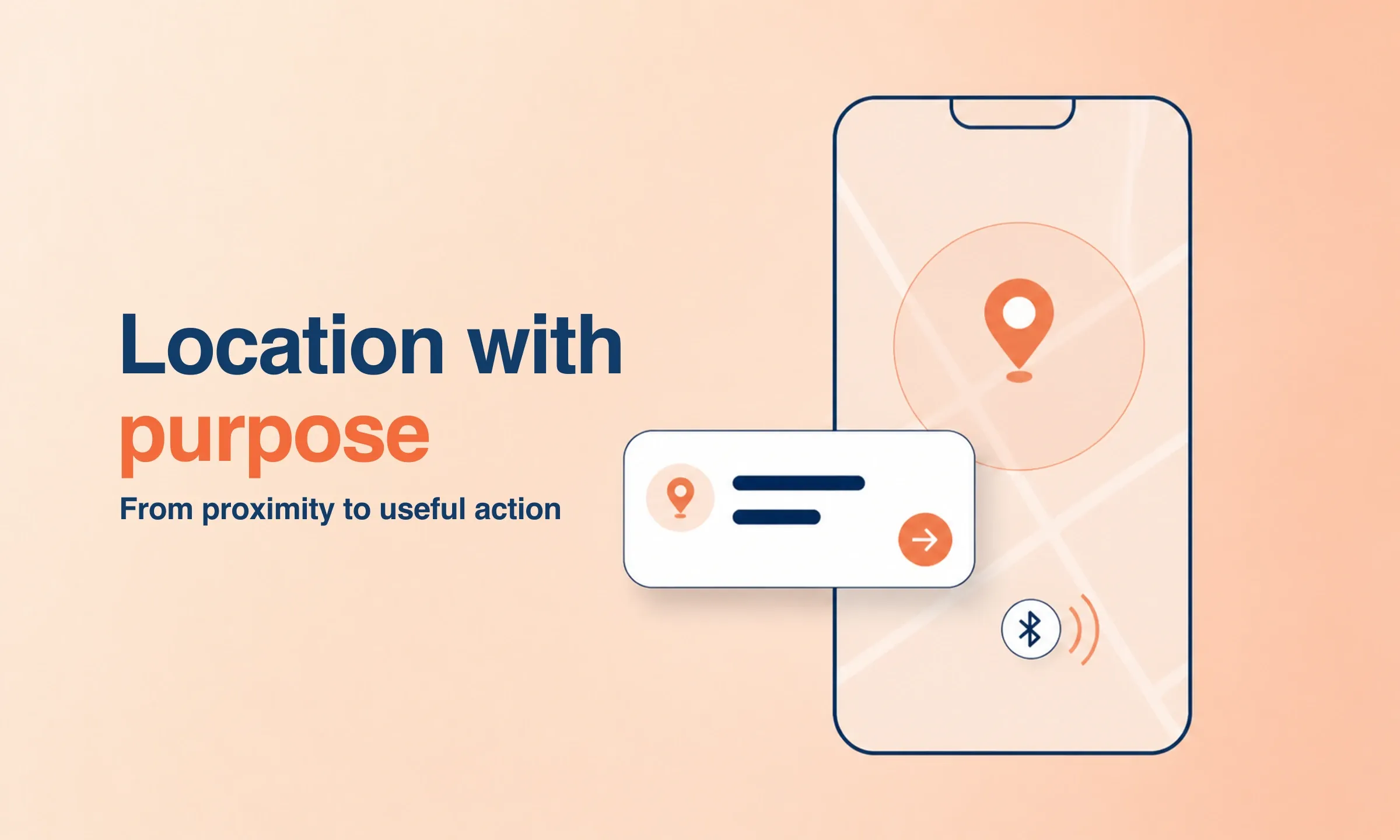
“You’re near our store. Come and visit us!”
This message knows where someone is, but not why the interruption matters. It offers no specific value or next step. At its best, location-based marketing uses proximity as context, not as the entire strategy.
Now compare it with:
“Your order is ready. You’re close to the pickup point—show this message at the counter.”
The second message connects a known person, a relevant place, the right moment and an immediate action. That same logic can guide a museum visit, an event alert or a local service—not only a promotion.
What location-based marketing actually means
Location-based marketing uses a person’s location or proximity to adapt a message, content or interaction. Depending on the experience, the underlying signal may come from GPS, Wi-Fi, cellular positioning or Bluetooth.
The terms around it overlap without meaning exactly the same thing. Geolocation marketing usually refers to personalization based on a position or geographic area. Geofencing marketing uses a virtual geographic boundary to trigger an action when a mobile user enters, exits or remains within an area. Proximity marketing focuses on interaction at short range, while beacon marketing uses a nearby Bluetooth signal to identify a much smaller context, such as a room or display.
Not every location-based experience requires an app: a local search result or geographically targeted ad can also use location. This guide focuses on notifications triggered in a compatible native mobile app, where the user’s permissions and the operating system are part of the experience.
Why location alone does not make a notification relevant
A location is a signal. Before creating a zone or installing a beacon, connect four elements:
- Person: Why does this information concern this user?
- Place: How does being here change its value?
- Moment: Why is the information useful now?
- Action: What can the user do immediately after opening it?
The weakest campaigns begin with “We can detect this place.” Stronger ones begin with a user need.
At a festival, “Welcome! See what’s happening” is vague. “The talk you saved starts in 10 minutes in Hall B—open the venue map” combines preference, time, location and navigation.
In a museum, “Discover our collection” adds little. Near a specific gallery, “Hear the curator explain the work in front of you” opens content that belongs to that room. Our guide to creating an app for museums shows how to build the app behind it, from the audio guide to the beacons placed in the rooms.
After a visit, a generic offer can feel opportunistic. A single reminder to retrieve a saved itinerary or complete an action begun on site may be useful—provided a delayed trigger would still make sense and the message is not repeated on every exit.
Remote push, geofencing or iBeacon?
Choose the trigger according to the physical precision and timing the experience needs.
| Method | What triggers it | Best suited for | Main requirements |
|---|---|---|---|
| Remote push | A scheduled campaign, publication or server-side event | Messages that do not depend on crossing a physical boundary | A compatible app and notification permission |
| Geofencing | Entry into, exit from or remaining within a geographic zone for a defined period | Outdoor areas, venues and their surroundings | A native app, location permission and App Store or Google Play compliance |
| iBeacon | Proximity to a registered Bluetooth beacon | Indoor spaces, rooms, aisles or specific points | A native app, physical beacon, Bluetooth and relevant permissions |
For a remote push, you choose when to send, and location can be one audience filter; crossing a boundary does not trigger the message. With geofencing or iBeacon, by contrast, the device detects a registered location condition and displays the configured alert.
A beacon does not send a notification itself. It broadcasts an identifier over Bluetooth; a compatible app recognizes the signal and applies the behavior associated with it.
Geofencing is generally better for a perimeter that can be represented on a map. A beacon is useful when “inside this building” is too broad and the interaction belongs to one room or point. For a fuller technical distinction, compare geofencing and beacons.
Location-based marketing examples by use case
The useful message depends on both the location signal and the action available at that moment.
| Use case | Location signal | Useful notification |
|---|---|---|
| Local news | Remote push targeted to a geographic area | “Roadworks begin tonight in your area—see the affected streets.” |
| Museum | iBeacon | “Listen to the commentary for the exhibit near you.” |
| Festival | Geofence | “You’ve arrived—open the venue map and today’s schedule.” |
| Retail | Geofence | “Open store hours and services for this location.” |
| Tourism | Geofence or iBeacon | “Discover the story behind this place.” |
The local-news example is deliberately a remote push: an editor chooses when to send it and location limits the audience. No boundary crossing triggers the message.
Design the moment before writing the message
Start with the action, not the radius. Define what the user should be able to complete: open a venue map, retrieve a ticket, hear nearby content, confirm attendance or use a service.
Then ask a simple question: Would this message still be useful ten kilometers away? If the answer is yes, a remote push may be enough. Location permission adds friction and should only be requested when place materially improves the interaction.
If location does matter, choose the least complex trigger that fits. An entry alert can welcome visitors or reveal access information. An exit alert can support a coherent post-visit action. A stay condition can avoid reacting to someone who merely passes the edge of a zone. An iBeacon can distinguish the lobby from an exhibition room when GPS cannot.
Write the value before the context. “Open the map for the entrance nearest you” is more useful than “You have entered our area.” The message should also open the promised destination rather than force the user to search from the Home page.
Finally, design the fallback. Location may be refused, notifications disabled, Bluetooth unavailable or a trigger delayed because positioning is not perfectly precise. Keep essential directions, schedules and tickets accessible inside the app. Never make a location alert the only route to information someone needs.
Ask for permission when the benefit is clear
Location access and notification permission are separate choices. Explain the feature in terms of what the user receives: “Allow location to receive venue guidance when you arrive” is more informative than “Allow location to improve your experience.”
Ask only for the access the enabled feature needs. Make the purpose clear when permission is requested, and display any prominent in-app disclosure required by the store before the system prompt. Users should also be able to understand how to turn the feature off.
Apple’s App Review Guidelines say that Location Services must be directly relevant to the app’s features, with notice and consent. Apple also requires an explicit opt-in and an in-app opt-out when push notifications are used for promotions or direct marketing.
On Google Play, location access in the background receives particular scrutiny. If an experience depends on location while the app is not visible, the access must provide a significant user benefit and be relevant to core functionality. Google says it must not be requested solely for advertising or analytics, and its declaration and approval process may apply. Review the current background location requirements before building a campaign around it.
These are App Store and Google Play compliance considerations, not legal advice. Your privacy policy and store declarations must describe the permissions and data uses of the app you actually submit. Our mobile app privacy checklist provides a broader preparation process.
Prevent notification fatigue and unintended triggers
A useful message can become irritating when its delivery rules are careless. Define how long someone must wait before receiving it again, and limit the active period to hours when the promised action is possible.
Account for people who cross the same boundary every day, including employees and residents. Avoid overlapping zones that can produce several alerts. Do not make a geofence so small that ordinary location variation turns its edge into a revolving door. Test entry, exit and stay conditions in the real place, on real devices, and decide whether a late alert would confuse the recipient.
Before activating a location-triggered notification, check:
- Does it provide immediate value?
- Can the same person receive it too often?
- Is the timing appropriate for the action?
- Does the destination match the message?
- Would a delayed or approximate trigger create confusion?
- Can the user complete the action immediately?
Measure the action, not just the alert
An open tells you the message attracted attention. It does not prove that the campaign improved a visit, registration or sale.
Measure at three levels:
- Delivery or exposure: eligible users, alerts triggered or displayed, and failures—where your tools provide those signals.
- Engagement: opens, visits to the linked destination and subsequent in-app behavior.
- Outcome: the action the experience was designed to support, such as a map opened, content played, attendance confirmed, coupon used or pickup completed.
The measurement method should be chosen with the campaign. Link to a dedicated destination, use a campaign-specific coupon or tagged URL, record an analytics event, or compare an exposed period or audience with a relevant baseline. If a physical outcome happens in a booking or checkout system, connect that evidence rather than treating notification performance as conversion.
Our guide to mobile app analytics explains how to turn usage signals into a measurement map and a concrete experiment.
Create location-triggered notifications with GoodBarber
GoodBarber separates messages sent remotely from alerts triggered by a place. In a native Content App, GoodBarber’s Geofencing extension lets you draw geographic areas and associate an automated notification with entry, exit or remaining within the area for a defined period. You can set an active period, control how long to wait before the same user receives the alert again and review notification performance.
For more precise indoor proximity, GoodBarber’s iBeacons extension associates a message with a physical Bluetooth beacon registered in the back office. You define the distance at which its signal should trigger the alert and can apply targeting settings to keep the message relevant.
These geoalerts are available for native iOS and Android Content Apps, not PWAs. Because the device evaluates the registered location condition, they differ from manual or automatic push notifications delivered remotely. GoodBarber’s Academy guide to push notifications explains the current setup, repetition controls, testing limits and publication implications without requiring you to build the mechanism yourself.
For remote campaigns, you can configure push notifications directly in GoodBarber’s back office. You can also ask an MCP-connected AI assistant to prepare a campaign from a natural-language instruction, including a native geographic zone, timing, platform filters and a tap destination. In this case, location filters the audience; it does not turn the remote campaign into a geofence trigger.
Use the Privacy Center and the compliance guide to review the permissions associated with the features you enable, then make the app, privacy policy and store declarations tell the same accurate story.
FAQ
Are geofencing notifications push notifications?
They are often called geofencing push notifications because they appear as device notifications. Technically, the trigger differs from a remote push campaign: the operating system detects that a registered location condition has been met, and the device displays the alert configured by the app.
What is the difference between geofencing, geotargeting and beacons?
Geotargeting uses location to select an audience or adapt the content shown to users in a particular area. Geofencing registers a virtual boundary and responds when a compatible device enters, exits or remains within it for a defined period. Beacons use a short-range Bluetooth signal to identify a smaller physical context, especially indoors.
Does location-based marketing require an app?
Not always. Local search, geographically targeted advertising and location-aware websites can operate without an installed app. However, alerts triggered by a geofence or iBeacon generally require a compatible native app, the relevant device capabilities and the user’s permissions.
Do GoodBarber geoalerts work in a PWA?
No. GoodBarber notifications triggered by geofencing and iBeacons are designed for native iOS and Android Content Apps. Remote manual and automatic push notifications are separate mechanisms and can also target compatible PWAs.
A useful location-based marketing strategy starts with one moment in which place genuinely changes the value of your app. Define the action, choose the least intrusive trigger, plan the fallback and decide how success will be measured before drawing the zone. Then explore GoodBarber’s Geofencing and iBeacons extensions to build that experience into your native app.


